















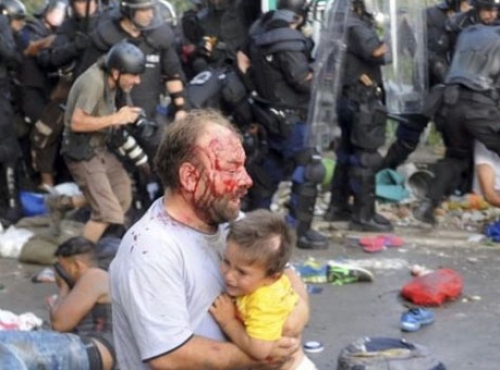


A daily flow of about 8,000 refugees to Europe is likely to continue, the United Nations warns, according to BBC News.
The figure came from UN regional coordinator for refugees, Amin Awad, in comments quoted by Reuters news agency. More than 5,000 refugees – many from Syria or Iraq – arrive daily in Greece.
That flow could continue during the winter if the weather remains good and the borders open, the International Organisation for Migration (IOM) told the BBC.
About half a million migrants – mostly from Syria and other conflict zones in the Middle East and Africa – have arrived in Europe this year.
Underneath the square in Victoria metro station, more Afghan families lie on the floor as commuters walk by. There are reports the Greek authorities may soon move all of them to facilities in one of the old Olympic parks in the southern suburbs. It is inevitable that the numbers of refugees and migrants on this and other squares in the capital will swell.
There are still more than 5,000 refugees and migrants – the majority of them Syrian – arriving every day on the Greek islands close to Turkey, according to Daniel Esdras, the head of the Athens branch of the International Organisation for Migration (IOM). And he believes the influx may continue throughout the winter if the weather remains good and the borders stay open on the route through the Balkans to Germany.
The influx has caused tensions between EU neighbours in Central Europe, which continued on Friday despite a visit to Austria by Hungary's Prime Minister Viktor Orban.
Deep divisions surfaced in the EU this week when ministers agreed to relocate about 120,000 refugees across Europe.
The refugees – from Syria, Iraq and Eritrea – will be transferred from Greece and Italy, to ease the pressure on overcrowded reception centres there.
However, there is still a dispute about the distribution plan. Hungary, Romania, the Czech Republic and Slovakia voted against it. They resent the imposition of quotas, arguing that they are ill-equipped to integrate non-EU migrants.
Many of the refugees are determined to reach Germany, whose Chancellor Angela Merkel has urged EU partners to take in more refugees. Germany expects to have at least 800,000 asylum seekers this year.
Germany's federal government has pledged €4bn (£3bn; $4.5bn) to its regional states, double the current levels of funding, to help them cope with a record migrant influx.