












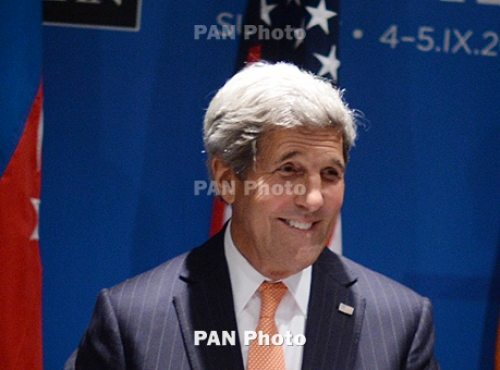


U.S. Secretary of State John Kerry called for the resumption of Syria peace talks Monday, March 14, in Geneva following a meeting with France's new foreign minister and other senior European diplomats.
Foreign Minister Jean-Marc Ayrault hosted Sunday's meeting in Paris which also included his British, German and Italian counterparts, and the European Union's foreign policy chief.
The meeting comes ahead of UN-sponsored indirect peace talks on Syria, which are scheduled to start Monday in Geneva amid a partial cease-fire that came into force two weeks ago and has mostly held.
"We look forward to the resumption of talks in Geneva on Monday," Kerry said in a joint news conference with his counterparts.
Delegations from the Syrian government and opposition, represented in part by the Saudi-backed High Negotiations Committee, arrived in Geneva Sunday, but with conflicting visions for the talks.
HNC spokesman Salem Mislet said the opposition would discuss the establishment of a transitional governing body in which Syrian President Bashar Assad and his associates would have no role.
"The Syrian people have submitted half a million martyrs not to keep Assad in power for a longer period but in order to terminate his presence and to put an end to the suffering of the Syrian people and also to put an end to the terrorism that targeted the region," he said.
But Syrian Foreign Minister Walid al-Moallam said Saturday any talk of removing Assad during the transitional period was "a red line," adding that the government rejected the U.N. envoy's call for presidential elections to be held in the next 18 months.
Kerry said Moallam's comments "clearly tried to disrupt the process" of negotiations.
Kerry insisted that both Iran and Russia — supporters of the Syrian regime — have adopted "an approach which dictates that there must be a political transition and that we must move toward a presidential election at some point of time."
The meeting's participants also issued a joint statement on Libya to express their support for the UN-sponsored unity government and call for its quick installation in the country's capital, Tripoli.
"Political unity and an inclusive and functioning government is the only way to put an end to the instability that has fueled the development of terrorism in Libya," the statement said.
Libya fell into chaos after the 2011 toppling and killing of longtime leader, Moammar Gadhafi. The country is ruled by two competing governments since 2014: an internationally-recognized body based in the eastern city of Tobruk and a rival one, backed by Islamist-allied militias, in Tripoli.
European Union countries are preparing possible sanctions against officials in Libya blamed for undermining the peace process. The issue will be discussed at a meeting of EU foreign ministers in Brussels on Monday.