










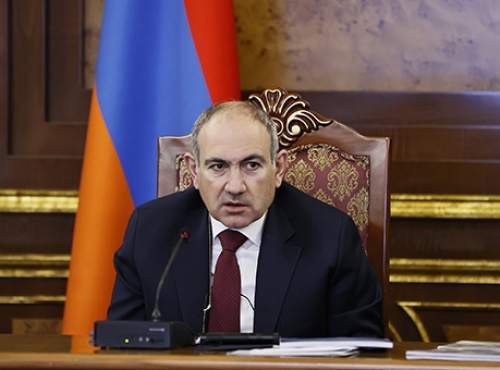


Armenian Prime Minister Nikol Pashinyan addressed the issue of regional transport corridor unblocking in a press conference. He stated that with Azerbaijan, they are considering numerous options that would simplify transit, but “there is currently no clear agreement or signed document.”
According to Pashinyan, Armenia already has several notable examples of outsourcing management—some successful, others less so.
“For instance, Zvartnots Airport is outsourced. I don’t believe that in any way undermines Armenia’s sovereignty, jurisdiction, or territorial integrity. The water system is outsourced. Previously, we had experience outsourcing HayPost, and so on. Railway management is also outsourced. The nuance is that both the railways, Zvartnots Airport, and the water system remain the property of the Republic of Armenia—this is important to note,” the prime minister said, as reported by Armenpress.
On the topic of transport routes, Pashinyan mentioned that establishing a company to attract investments is under discussion, since the Crossroads of Peace project requires enormous capital and needs consolidated investment mechanisms.
He explained that the project encompasses not only roads and railways but also pipelines—oil, gas, power lines, telecommunications cables, etc.
“It’s an economy that must be managed and built. It should, in our view, remain Armenia’s property. This involves governing that economy and executing functions within it. Since there’s quite a lot of discussion around leasing, including land leases, I want to clarify that under Armenian law, what I’ve mentioned is termed a ‘build‑operate right’. Under this model, investments made stay or become Armenia’s property once the contract ends,” the prime minister said.
Pashinyan noted he cannot provide specifics now because various ideas are being discussed. He said that if a definitive agreement had been reached, he could speak about it.
“I’ve now outlined the scope of discussions,” he stated.
Regarding transport corridors, Pashinyan noted that in the Crossroads of Peace project, Armenia has also offered certain simplifications for route unblocking.
“Today, countries compete to channel cargoes and energy carriers through their territories. This must be considered,” the prime minister said.
He expressed surprise at the notion that reopening railways through Armenia is seen by some as a tragedy, when the real tragedy is the absence of transit rail passing through Armenia.
“If Armenia were—and will be, and I’m confident it will be—a transit hub for international cargo, that would become a crucial security factor,” Pashinyan said.
He added that the clarifications around regional corridor unblocking relate to applying various cross‑border technologies used internationally.
“One thing is clear: we want to make Armenia a transit country—internationally, regionally, globally—and, of course, we must offer the most attractive conditions to properly convince global investors that this is the right path,” he stressed.
On July 10, Prime Minister Nikol Pashinyan and Azerbaijan’s President Ilham Aliyev met in Abu Dhabi to discuss various aspects of Armenia‑Azerbaijan interstate relations. They confirmed that bilateral talks are the most effective format to address all issues in the normalization process, and agreed to continue such result‑oriented dialogue. The meeting lasted five hours.