










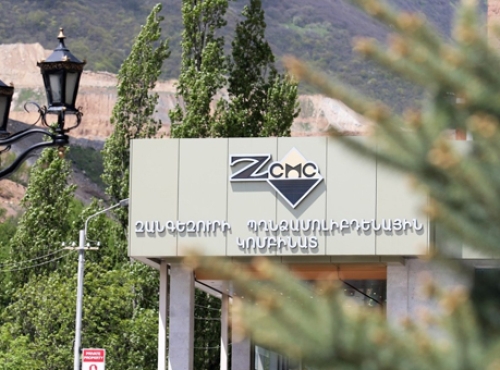


There is no seismic risk recorded at the Artsvanik tailings dam operated by the Zangezur Copper-Molybdenum Combine (ZCMC), according to Ardzvin Tsatryan, acting head of the company’s environmental department.
Tsatryan stated that monthly reports are compiled based on seismic sensors installed in different sections of the dam, recording underground tremors and their potential impact. In areas showing movement, tailings discharge is suspended to allow for reinforcement works, reports Sputnik Armenia.
“In the past 10 years, earthquakes of up to magnitude 7 have been recorded in Syunik, but we have not registered any significant damage to our infrastructure,” Tsatryan noted.
Aside from seismic factors, dam reliability can also be affected by accumulated water, as ore processing involves the use of water and reagents, leaving the tailings moist. To reduce pressure on the dam, pumps are installed to remove excess liquid.
Both local and international experts, including the Mining and Metallurgy Institute, assess the dam’s stability. The company annually studies local flora and fauna to support future land reclamation. This includes collecting and restoring the topsoil to replant original vegetation.
“We remove the top layer of soil in advance and later spread it back with the same plant species. The difference from the original state is minimal,” added Tsatryan.
Water from the dam’s main section is filtered through a tower and discharged into a sedimentation pond, eventually flowing into the Achanan River. Daily samples are taken both at the discharge point and downstream to assess irrigation water quality.
“We compare water composition before and after our operations. The difference is minor. Occasionally, there are deviations from norms, which we report and, if fined, the company pays,” Tsatryan said.
The Artsvanik dam, in use since 1977, lies about 35 kilometers from the processing plant. Used ore is pumped via pipelines, the main one measuring 1000 mm in diameter, supported by two 720 mm backup lines. A new 1220 mm line is under consideration. The dam’s permitted fill level is 1015 meters above sea level; currently, it stands at approximately 950 meters. The last major incident was in October 2019, when the Voghji River was polluted. Since then, only minor technical issues have been recorded and promptly addressed.