






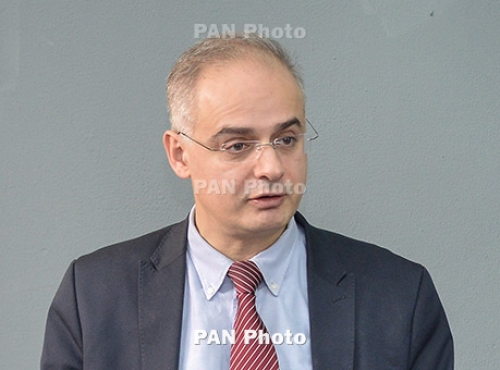


Deputy Chairman of the Armenian National Congress, Levon Zurabyan, emphasized that the so-called “Zangezur Corridor” is, first and foremost, an Azerbaijani project, then a pan-Turkic one, and now increasingly a geopolitical initiative.
He stressed that Syunik is Armenia’s trump card and strategic asset, currently at the center of global competition.
“Azerbaijan wants to take control of Zangezur and re-establish a connection between Nakhichevan and Turkey.
Secondly, this is a pan-Turkic project aimed at creating a corridor of economic cooperation and connectivity between Turkey and the broader Turkic world.
And now it has become geopolitical—Russia, China, and Iran on one side, and the West on the other, all care deeply about who controls this project.
The signing of the November 9, 2020, trilateral statement by Russia was an attempt to bring the project under its control. Naturally, the West could not accept that and pressured Prime Minister Pashinyan to derail the plan, even at the cost of losing Karabakh.
Later, the goal became to bring the project under Western influence, even if it meant destroying Armenia’s sovereignty and gradual Azerbaijani encroachment.
We must understand that Syunik is our asset and trump card in this geopolitical game.
When you hold such a card, you’re in a difficult position—it demands exceptional diplomacy to come out on top. The real challenge is how you use it. Otherwise, others will seize it and tear it apart.
This is where your skill matters—how to turn a trump card into a working asset. That’s exactly what Azerbaijan did with its oil in 1994 through the 'Contract of the Century,' when Heydar Aliyev negotiated with all major geopolitical players and aligned their interests.
Armenia now needs a similar ‘Contract of the Century.’
Right now, we are following the path Azerbaijan took in 1992–1993, and the parallels between Pashinyan and Elchibey are no coincidence.
Just as Elchibey steered Azerbaijan toward NATO and Turkey—leading to its collapse before Aliyev took over—Pashinyan is taking Armenia down a geopolitical road where he has no chance of winning,” Zurabyan wrote.
He added that if Armenia had a proper government capable of balanced diplomacy and harmonizing competing geopolitical interests, the situation would be entirely different.
“This is an extremely complex issue, and the solution lies in a vision we’ve long advocated for and included in our 2021 platform.
Given Syunik’s geopolitical significance, it should become a transportation hub where North-South and East-West railways intersect. By creating a consortium and aligning the interests of multiple states, Armenia could remove itself from this fatal geopolitical rivalry.
Such a solution requires complex diplomacy. But right now, we have what we have—an Elchibey-style government,” the statement concluded.
At a global media forum, Ilham Aliyev reinforced the Zangezur corridor rhetoric, declaring that Azerbaijani cargo and citizens should not face Armenian border guards or any intermediaries. He said the issue was also raised during his meeting with Armenia’s prime minister in Abu Dhabi, adding that no operators or leases would exist on their territory. In response, PM’s spokesperson Nazeli Baghdasaryan reiterated that Armenia has never discussed, is not discussing, and will not discuss the terminology or logic presented by Aliyev. She emphasized that his remarks do not reflect the content of real negotiations.