









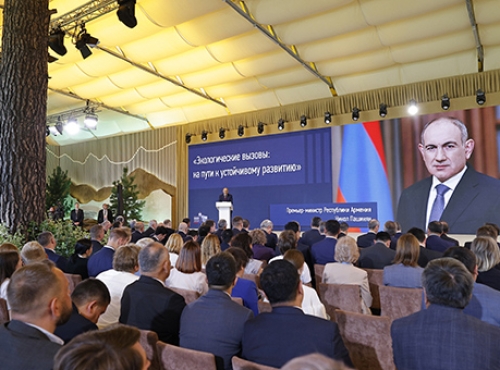


Armenian Prime Minister Nikol Pashinyan took part in an international environmental forum held in Russia’s Altai region, focusing on nature protection and climate challenges. In his speech, he welcomed the climate-related cooperation among member states of the Eurasian Economic Union (EAEU).
Pashinyan emphasized that Armenia is among the countries most affected by global warming.
“Armenia is a mountainous country, with 80% of its territory lying in high-altitude zones. It is known for its diverse climate zones, ranging from dry subtropical to alpine. The country is home to many endemic species of flora and fauna. Four national parks and three nature reserves cover more than 10% of Armenia’s land, including the Khosrov Forest Reserve, founded in the 4th century as a royal hunting ground. Lake Sevan, Armenia’s crown jewel, is the largest freshwater reservoir in the region.
Our mountain ecosystems are highly vulnerable to climate change. Droughts, floods, and mudslides have become more frequent. Although Armenia’s carbon dioxide emissions are globally negligible, we are still severely impacted by climate shifts,” Pashinyan stated.
He detailed climate impacts such as accelerated glacier melt, reduced precipitation, landslides, soil erosion, and desertification. Water shortages, he said, are affecting the productivity of pastures and farmlands and reducing forest resources. Armenia is prioritizing improved water use efficiency, introducing innovative technologies, and expanding drip irrigation programs.
To address these issues, the government adopted a Climate Change Adaptation Program for the Water Sector (2022–2026), and a draft “Law on Climate” has been developed to establish a legal and institutional framework for climate policy. In 2021, Armenia adopted its National Adaptation Plan and a five-year implementation schedule, laying a foundation for continuous climate adaptation efforts.
Highlighting biodiversity, Pashinyan noted Armenia’s wildlife restoration programs. Since 2002, a joint project with the World Wildlife Fund has yielded tangible results in restoring the Caucasian leopard population. Permanent habitation and breeding of the species have been recorded, indicating a stable habitat and food base. A similar project is underway in Dilijan to restore the population of the Caucasian red deer.
Pashinyan also stressed Armenia’s support for mountain country agendas within the United Nations. Armenia actively engages with the Mountain Countries’ Friends Group, initiated by Kyrgyzstan, and has joined the Kyrgyz proposal for a “Mountain Partnership Group” within the UN Framework Convention on Climate Change. Armenia aims to contribute to shaping the group’s climate agenda and advancing its role in climate negotiations.
“The 17th Conference of the Parties to the Convention on Biological Diversity (COP-17) will be held in Armenia in 2026. We look forward to welcoming high-level delegations, along with academic and expert representatives from your countries.
As host and presiding nation, Armenia will strive to foster effective dialogue, align positions, and achieve balanced and meaningful decisions reflecting the interests and priorities of all parties. We are confident that together, we can make a significant contribution to preserving biodiversity and using our natural environment responsibly, in the spirit of shared responsibility for our planet,” said Pashinyan.
The event was attended by government leaders from Russia, Kazakhstan, Kyrgyzstan, Belarus, Tajikistan, Uzbekistan, and Turkmenistan.