









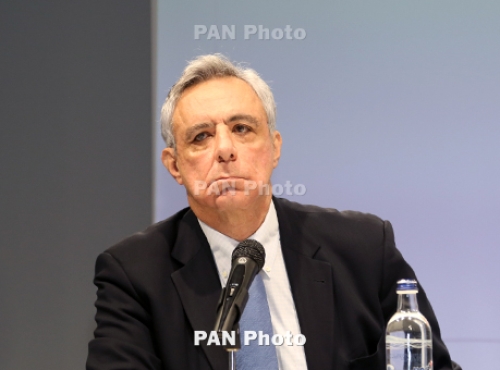


Former Armenian Foreign Minister Vartan Oskanian has accused the European Union of silently abetting Armenia’s descent into authoritarianism, claiming the bloc is turning a blind eye to the erosion of democracy in the country.
In a Facebook post, Oskanian said Armenia is abandoning democratic governance, with the European Union remaining passively observant. “This is not merely silence,” he wrote. “The EU, along with its member state embassies in Yerevan, is complicit—through deliberate inaction, diplomatic hesitation, and strategic cynicism.”
He emphasized that for decades, the West has invested hundreds of millions of euros to support reforms in Armenia—strengthening its judiciary, police, media, and civil society. “Today, these institutions are being used by the government of Nikol Pashinyan as instruments of repression rather than pillars of democracy,” Oskanian stated. “Yet the EU continues as a passive observer, clearly unwilling to let principles interfere with political expediency.”
Oskanian described the past five years as disastrous for Armenia. The country lost Nagorno-Karabakh, parts of its sovereign territory, and now faces threats to its independence due to Azerbaijani border incursions and extraterritorial corridor demands. “Now, democracy itself is under siege by a regime more focused on silencing critics than defending the state.”
He further alleged that dozens of political prisoners are being held in Armenian prisons, with their only “crime” being criticism of Pashinyan’s policies. “This is no accident,” he said, “but a coordinated campaign of repression. Opposition leaders are being persecuted or imprisoned. The judiciary has become an extension of the executive. Preventive detention is abused. The government exploits democratic frameworks to dismantle democracy—and the EU pretends not to notice.”
Oskanian also condemned the government’s campaign against the Armenian Apostolic Church, calling it a dangerous escalation. Pashinyan’s efforts to discredit, delegitimize, and dismantle the Church are not merely political, he warned, but civilizational. “Such a state assault on a historical national institution through legal pressure, media defamation, and administrative harassment would spark diplomatic outrage elsewhere. In Armenia, EU representatives simply look away.”
He argued that Brussels views the South Caucasus not through the lens of democratic values, but purely geopolitical interests—as a transit corridor for Caspian oil and gas, a counterweight to Russian influence, and a buffer between Iran and the Black Sea. “Today, appeasement drives EU policy toward Armenia. As long as Yerevan doesn’t disrupt energy flows or challenge the illusion of peace with Azerbaijan, the EU is willing to overlook internal repression.”
Oskanian warned that the EU’s silence harms the Armenian people and sets a dangerous precedent for future governments by fostering a sense of impunity regardless of ideology. “Brussels is betraying its own democratic principles and losing what little credibility it retains. When Europe finally decides to speak up, it may find no one left in Armenia willing to listen.”
“There’s still time to reverse course, but the window is closing,” he concluded. “Silence is not neutrality—it is complicity. If the EU continues to ignore repression, it risks losing both its moral authority in Armenia and its strategic relevance in the entire region.”