








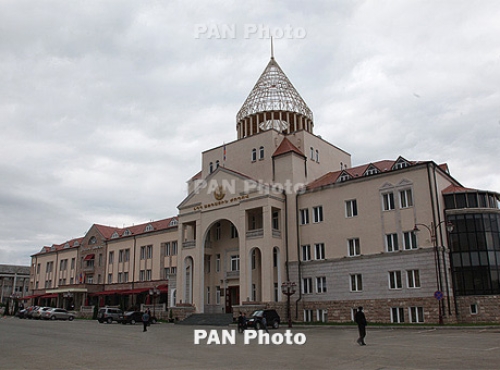


The National Assembly of Artsakh responded to the outcomes of the summit in Washington between Armenian, Azerbaijani, and U.S. leaders.
The parliamentary factions issued a statement noting that, prior to 2020, the Minsk Group co‑chairs had reassured the people of Nagorno‑Karabakh at the highest presidential level that the conflict had only a peaceful resolution.
They assert that the co‑chairs chose “the easiest path” by foregoing their mediator and peacemaker responsibilities:
“The National Assembly of the Republic of Artsakh values the longstanding efforts of the international community to strengthen peace and stability in the South Caucasus. As a Minsk Group co‑chair, the United States played an important role in the settlement process, appreciated by Artsakh’s people and authorities.
Through years of consistent, patient work, the U.S., together with France and Russia, presented a peace formula aligned with international law—the Madrid Principles—emphasizing the prohibition of the use of force, the right to self‑determination, and territorial integrity. Until 2020, the Minsk Group co‑chairs, at the presidential level, assured Artsakh’s people that the issue has only a peaceful resolution based on such principles.
But everything collapsed with Azerbaijan’s broad aggression of September 27, 2020, and failure to condemn it led to a monumental tragedy: 150,000 people were displaced from their ancestral land under threat of genocide and found refuge in Armenia.
It was expected that powerful international centers, especially the Minsk Group co‑chairs, would respond quickly with solutions. Sadly, they chose the “easiest” route—refusing their peacemaker obligations under varying pretexts. By ignoring the binding ruling of the International Court of Justice reaffirming Artsakh’s people’s right to return safely to their historic homeland, they effectively encouraged a crime against humanity.
No one understands the necessity of peace and sustainable development better than the people of Artsakh, who endured deprivation, sacrifice, and a nearly ten‑month blockade orchestrated by Azerbaijan. Yet such developments cannot bring the genuine peace needed by all regional peoples.
We believe that the Armenian authorities’ stance on ignoring Artsakh’s fundamental rights may offer an illusion of success on the international security agenda—but is likely to lead to deep disappointment among genuine peacemakers.
We are convinced the normalization package between Armenia and Azerbaijan must include:
- The right of Artsakh’s people to return safely and with dignity to their historic homes.
- Protection of Artsakh’s spiritual and cultural heritage, now gravely endangered by Azerbaijani occupation.
- Resolution of unresolved issues concerning Armenian prisoners of war and civilians—including former Artsakh political‑military leaders—whose rights are violated and who face unlawful trials in Baku prisons.
Under such circumstances, the start of dismantling the Minsk Group reveals the co‑chairs’ inconsistent foreign policy, damages their credibility, and proves that small or “less strategic” regions continue to be treated as expendable in great‑power politics.
The National Assembly of Artsakh warns against attempts to conceal responsibility of those who failed at the mission of peace, and reaffirms its commitment to real peace built on justice, rule of law, and mutual trust.”
In line with prior agreements, on August11, a joint appeal and draft decision concerning the dissolution of the OSCE Minsk process and its structures were circulated among OSCE participating states. The decision originated in Washington under U.S. President Donald Trump’s auspices, within the framework of a normalization agreement between Azerbaijani President Ilham Aliyev and Armenian Prime Minister Nikol Pashinyan. The Minsk Group was created in 1992 to resolve the Karabakh conflict. France welcomed the call to begin dismantling its structures, and the group’s co‑chairs are the U.S., France, and Russia.