







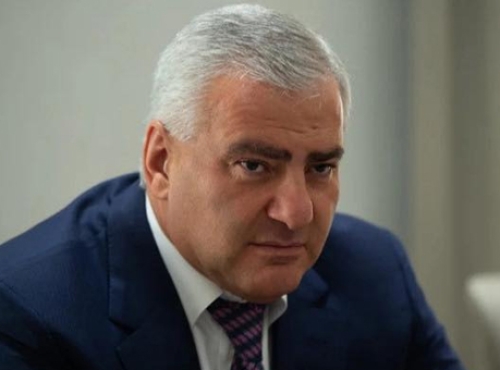


Samvel Karapetyan’s legal team has released a statement from internationally recognized lawyer Geoffrey Robertson, asserting that “any reasonable judge can clearly see that Samvel Karapetyan has done nothing illegal.”
Robertson emphasized that the ongoing actions against Karapetyan “blatantly violate fundamental human rights and freedoms,” and described his prolonged detention as “clearly unlawful.”
“He merely responded to exaggerated and provocative attacks by the Prime Minister against him and his Church,” Robertson explained. Karapetyan’s initial remarks, made in response to a public question, framed the attack on the Church as an attack on the people. He said he would stand with the Church “in our way,” which, Robertson argued, at most implies public support or advocacy—not incitement to violence or criminal activity.
“No democratic country where freedom of expression is constitutionally protected, as it is in Armenia and under its international obligations, can reasonably interpret Karapetyan’s words as criminal,” he continued.
Robertson stressed that Karapetyan made no call to overthrow the government by force—the alleged crime for which he is being detained—and thus “there is no legal basis for his imprisonment.”
He added that even if the Prime Minister had reasons to criticize the Church or Karapetyan, that is irrelevant to Karapetyan’s right to respond, provided he did not incite violence or rebellion. According to Robertson, “clear evidence shows he did no such thing.” He cited case law from the European Court of Human Rights that protects broader criticism of governments, particularly on matters of public interest.
The Armenian Criminal Code’s Article 422 requires proof that a public statement contained a call to seize power or violently overthrow the constitutional order. “Using this provision against a believer who expressed peaceful dissent, without promoting violence, is a flagrant violation of Article 10 of the European Convention on Human Rights,” Robertson stated.
He warned that when abuse of power occurs and Parliament is unable or unwilling to intervene, the duty to correct such abuses lies with an independent judiciary. “Does Armenia have such a judiciary?” he questioned, adding that the Karapetyan case raises serious doubts.
Karapetyan has been in pretrial detention for over 100 days. Both the trial and appeals courts denied bail, without addressing the lack of legal grounds for the charges.
Authorities claim the investigation is ongoing, despite the fact that the charges are based solely on two public statements Karapetyan never denied. Robertson called the continued investigation “absurd,” noting that no witnesses are needed, as the case hinges entirely on legal interpretation.
“These judges have failed in their duty to protect free expression,” Robertson concluded, warning that their decision has denied Karapetyan the right to freely express his views and criticize the government without promoting violence.
Karapetyan, he said, is being persecuted simply for supporting the Church and criticizing the government. His statements, provoked by the Prime Minister, “cannot reasonably be seen as incitement to violence or rebellion.”
Robertson concluded that the actions against Karapetyan are in clear violation of fundamental rights and that his detention is unlawful. The failure of both trial and appeals courts to address the baseless charges casts serious doubt on Armenia’s ability to provide effective judicial protection.
On June 17, authorities searched Karapetyan’s home after he publicly expressed support for the Armenian Apostolic Church. He was detained the next day for two months. On August 15, Anti-Corruption Court Judge Tigran Davtyan extended his detention for another two months. Karapetyan is charged under Articles 290 (tax evasion), 296 (money laundering), and 422 (calls for seizure of power) of the Criminal Code. On October 13, prosecutors added a new count under Article 296, part 3, points 2 and 3, for large-scale money laundering using official position or influence.