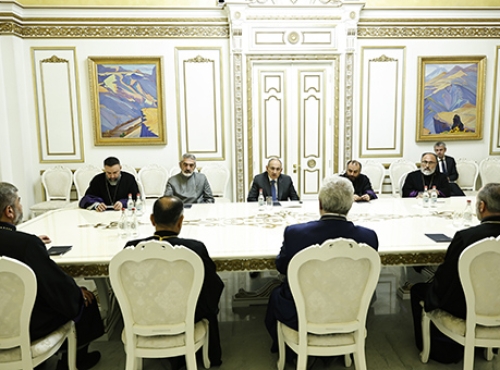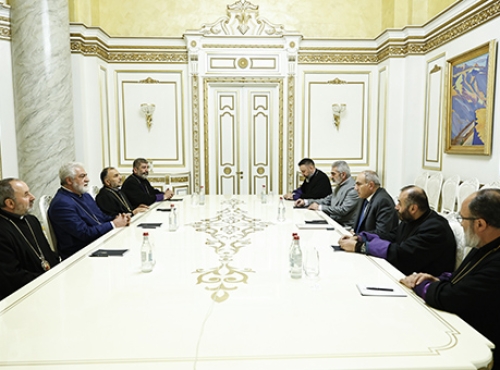














Armenian President Serzh Sargsyana has received Co-Chairs of OSCE Minsk Group, diplomats Yuri Merzlyakov (Russia) and Robert Bradtke (U.S.). Present At the meeting was also representative of OSCE Chairman-in-Office, Ambassador Anjey Kasprzyk and RA Foreign Minister Edward Nalbandyan.
The OSCE Minsk Group was created in 1992 by the Conference on Security and Cooperation in Europe (CSCE, now Organization for Security and Co-operation in Europe (OSCE)) to encourage a peaceful, negotiated resolution to the Nagorno Karabakh conflict.
On 6 December 1994, the Budapest Summit decided to establish a co-chairmanship for the process.
Implementing the Budapest decision, the Chairman-in-Office issued on 23 March 1995, the mandate for the Co-Chairmen of the Minsk Process.
The main objectives of the Minsk Process are as follows: Providing an appropriate framework for conflict resolution in the way of assuring the negotiation process supported by the Minsk Group; Obtaining conclusion by the Parties of an agreement on the cessation of the armed conflict in order to permit the convening of the Minsk Conference; Promoting the peace process by deploying OSCE multinational peacekeeping forces.
The Minsk Process can be considered to be successfully concluded if the objectives referred to above are fully met.
The Minsk Group is headed by a Co-Chairmanship consisting of France, Russia and the United States. Furthermore, the Minsk Group also includes the following participating States: Belarus, Germany, Italy, Portugal, the Netherlands, Sweden, Finland, Turkey as well as Armenia and Azerbaijan. Current Co-chairmen of the Minsk Group are: Ambassador Bernard Fassier of France, Ambassador Yuri Merzlyakov of the Russian Federation and Ambassador Robert Bradtke of the United States.
The Collective Security Treaty Organization, formed under the framework of the Commonwealth of Independent States, serves as a mutual defense alliance among Russia, Armenia, Belarus, Kazakhstan, Kyrgyzstan, and Tajikistan. The Collective Security Treaty (CST) was signed on May 15, 1992 for five-year term, with the possibility of prolongation. On December 2, 2004 the General Assembly of the United Nations adopted the Resolution to grant the observer status to the Collective Security Treaty Organization in the General Assembly of the United Nations. The goal of the Collective Security Treaty Organization is to strengthen peace and international and regional security and stability and to ensure collective protection of independence, territorial integrity and sovereignty of Member States, in the attainment of which Member States shall give priority to political methods. On February 4, 2009, the CSTO leaders approved formation of Collective Rapid Reaction Force (RRF).
The Karabakh-Azerbaijani conflict broke out in 1988 as result of the ethnic cleansing launched by Azerbaijan in the final years of the Soviet Union. The Karabakh War was fought from 1991 to 1994. Since the ceasefire in 1994, most of Nagorno Karabakh and several regions of Azerbaijan around it (the security zone) remain under the control of Nagorno Karabakh defense army. Armenia and Azerbaijan have since been holding peace talks mediated by the OSCE Minsk Group.