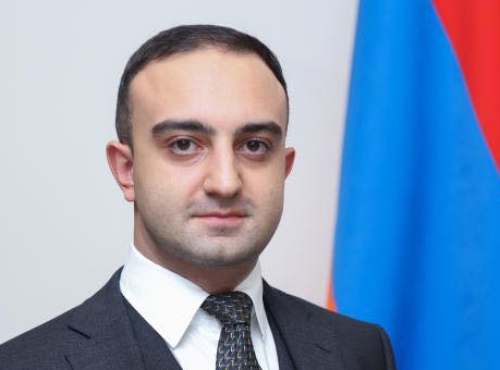















“I think Azerbaijan’s reaction is not adequate response to the call of the Armenian President to sign an agreement on nonuse of force,” Artak Zakaryan , member of the Republican Party of Armenia (RPA) told a news conference jointly held with expert Anush Setrakyan in Yerevan.
According to him, Baku has once again demonstrated its unconstructive position on the Karabakh conflict settlement issue.
According to Zakaryan, whether Turkey will ratify the Armenian-Turkish protocols or not, Armenia will win. Zakaryan did not rule out that Ankara will ratify the Protocols and try to unfreeze the process. “But this does not mean that we should not expect unpredictable steps from Turkey,” Artak Zakaryan said.
However, according to him, it is wrong to specify any terms for Protocols’ ratification because it is rather a complex process.
According to Anush Sedrakyan, Armenia has become the source of tension in the region, while Azerbaijan and Turkey have adopted pro-Russian position.
The threat of war has always existed and the only culprit of this is Azerbaijan, Mr. Zakaryan said.
The armed conflict between Nagorno Karabakh and Azerbaijan broke out in 1998, as result of the ethnic cleansing the latter launched in the final years of the Soviet Union. The Karabakh War was fought from 1991 (when the Nagorno Karabakh Republic was proclaimed) to 1994 (when a ceasefire was sealed by Armenia, NKR and Azerbaijan). Most of Nagorno Karabakh and a security zone consisting of 7 regions is now under control of NKR defense army. Armenia and Azerbaijan are holding peace talks mediated by the OSCE Minsk Group up till now.
The Protocols aimed at normalization of bilateral ties and opening of the border between Armenia and Turkey were signed in Zurich by Armenian Foreign Minister Edward Nalbandian and his Turkish counterpart Ahmet Davutoglu on October 10, 2009, after a series of diplomatic talks held through Swiss mediation. On January 12, 2010, the Constitutional Court of the Republic of Armenia found the protocols conformable to the country’s Organic Law.