



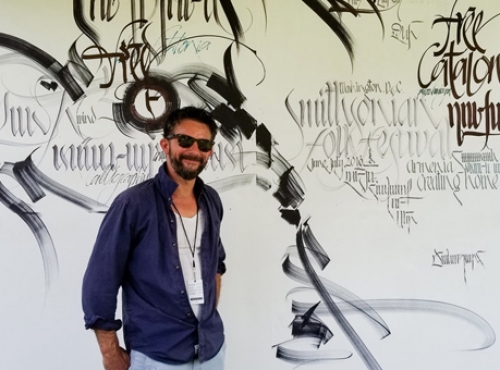


Ruben Malayan, a lean, goateed artist, is teaching kids and visitors at the Smithsonian Folklife Festival in Washington, D.C., to write the letter "A" in Armenian calligraphy, the National Public Radio says.
On a sheet of computer paper, he inks a shape that looks like an old English "W," using a pen with a flat metal nib. His strokes — black line after black line, in perfect symmetrical succession — are hypnotic.
"It's like a rhythm, like you're playing the piano," Malayan says as he draws. "Long notes, long lines, short notes, short lines." The students watch him for a beat, then practice scratching out their own lines. Over the past two weeks, he's been teaching workshops and talking about Armenian calligraphy under a little white tent at the festival.
Back home in Armenia, Malayan, 47, is a painter, a graphic artist and the creator of the iconic protest posters that became a symbol of his country's revolution in April.
Using a mix of traditional calligraphy and bold block script, Malayan hand-painted signs that said "defend the revolution" and "be brave" — then gave them away to people in the streets. Protesters used these fierce slogans to pressure Prime Minister Serzh Sargsyan to step down. And a few weeks later, he did.'
A report from Al Jazeera in May called Malayan's placards the "pop art of the revolution."
Malayan, also a professor of visual communication at the American University of Armenia, is the author of The Art of Armenian Calligraphy. He's trying to revive the art of calligraphy in his country.