






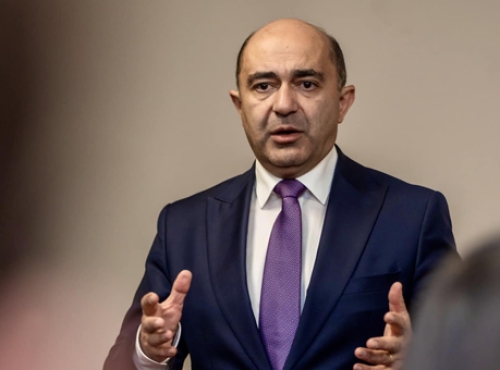


Edmon Marukyan, leader of the Bright Armenia party, addressed Azerbaijan's demand for unimpeded transit to Nakhichevan in a Facebook post, asserting that the obligation for an "unimpeded road" arose from Artsakh's existence—if Artsakh no longer exists, neither does this obligation.
"For over a year, I have been explaining in classical Armenian that we must return to the trilateral format of November 9 and demand the return of the people of Nagorno-Karabakh to Artsakh.
I say—demand the return of Russian peacekeepers and security guarantees in Artsakh, demand the Lachin corridor as it was before the blockade, and officially declare that Armenia will ensure the implementation of Clause 9 only if Russia and Azerbaijan fulfill these conditions as stated in the trilateral declaration.
If they refuse to restore the November 9 negotiation process, our stance on Clause 9 should be the same," the statement reads.
Marukyan emphasized that there is no standalone obligation to provide an "unimpeded road" or "corridor" if Nagorno-Karabakh no longer exists.
"It must be clearly stated that the obligation for an 'unimpeded road' was born out of Nagorno-Karabakh’s existence, and if Nagorno-Karabakh no longer exists under these provisions, then neither does this obligation. Do you understand that there is no separate obligation to grant an 'unimpeded road' or a 'corridor' if Nagorno-Karabakh is gone?
The government consistently claims it is ready to provide an 'unimpeded' road. I ask—what in return? Again unilaterally, again without demanding our own interests? What do you call this phenomenon, when what belongs to you has been taken, you are considered the debtor, and you are not even intent on asserting your rightful claims?
This is what I have been demanding and explaining for a year, but the Turkish-Azerbaijani network distorts it so that no one understands what can still be done, how we can still negotiate and preserve our territorial integrity and sovereignty peacefully, and ultimately, how we can avoid another war," he wrote.
On September 19, 2023, Azerbaijan launched a large-scale attack on Artsakh, subjecting the entire region to heavy shelling. As a result, on September 20, Artsakh authorities agreed to a ceasefire proposed by the Russian peacekeeping mission, accepting Baku’s terms, including the disarmament of the Artsakh Defense Army and the dissolution of the Republic of Artsakh. On September 24, the forced displacement of Artsakh Armenians began, with over 100,000 people forcibly relocated to Armenia. According to reports, only about 20 Armenians remain in Artsakh. On September 28, Artsakh President Samvel Shahramanyan signed a decree dissolving the republic, which took effect on January 1, 2024.