





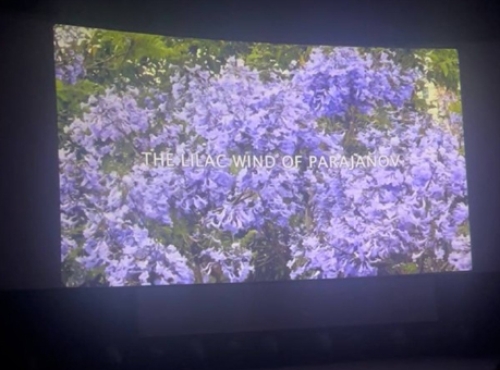


A documentary titled Parajanov’s Lilac Wind, directed by Ali Khamraev, premiered on July 16 at the Golden Apricot festival, celebrating the renowned filmmaker’s 100th birthday.
The film highlights the close working and personal relationship between Khamraev and Parajanov, portraying its profound impact on the Uzbek director’s heart, reports Factor.am .
Shot first at the 54th Rotterdam Film Festival, the documentary received international acclaim and involved contributors from various post-Soviet cinema traditions. Its title refers to Parajanov asking his sound director to capture the “lilac wind’s voice.”
Producer Gars Khachatryan recalled their 40‑year friendship, beginning with their meeting in Yerevan in autumn 1985, and described his honor at being invited to the production in recent years.
The film features rare photos and footage of Parajanov, including unique scenes from a hospital in Saint‑Louis, alongside recollections from contemporaries and friends: from Artavazd Peleshyan to Tigran Mansuryan.
Filming took place across several countries—Armenia, Italy, Georgia, Ukraine, Uzbekistan, and Russia—and includes Parajanov’s visit to Tashkent, where he met admirers. Khamraev notes the film is deeply personal, depicting Parajanov as he knew him.
Khamraev shared that the idea emerged in spring 2023. He wrote the script, Yuri Klimenko served as cinematographer, and initial video messages at the screening came from director Roman Balayan and Khamraev himself.
He recounted proposing the project to Klimenko: “You are cinematographer, I am director—let’s do this.” He later involved Balayan (a devoted Parajanov admirer who knew him personally), Khachatryan, and the Parajanov museum, enabling successful filming in Yerevan.
Khachatryan emphasized the importance of footage shot in Ukraine during the war: “Several significant scenes were filmed there, and Roman Balayan’s stories were recorded in Kyiv.”
Photographer Yuri Mechitov, who captured Parajanov frequently, told Factor TV that the film’s value lies in its creators’ personal acquaintance with Parajanov. He noted he photographed Parajanov about 2,000 times, regretting not capturing all his “amazing, maddening stories—for example, about prison life. He said, ‘Soviet power made me a genius.’ He always had something to say.”
Khachatryan added that the documentary may soon appear at international festivals as a tribute and act of gratitude to Parajanov.
We offered this as our homage and confession to Parajanov, he said.