






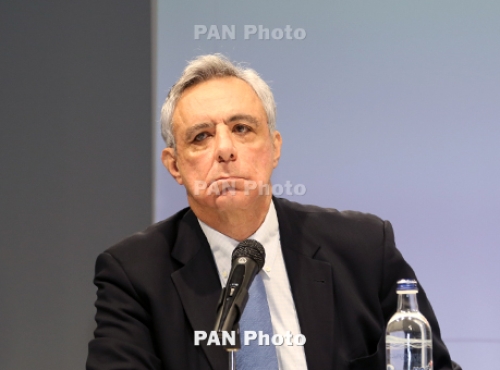


Former Armenian Foreign Minister Vartan Oskanian has responded to a resolution adopted by the Belgian Parliament regarding Nagorno-Karabakh, which condemns Azerbaijan’s actions and stresses the need for the return of displaced Armenians.
On July 18, Belgium's legislative body passed a resolution condemning violence and human rights violations by Azerbaijan in Nagorno-Karabakh. The document urges Baku to comply with the International Court of Justice ruling from November 17, 2023, which requires Azerbaijan to ensure the safe return of displaced Armenians under international supervision.
This initiative aligns with two 2024 resolutions adopted by the European Parliament and a recent proposal by the Swiss Parliament aimed at mediating between Azerbaijan and the Armenians of Nagorno-Karabakh to support their return. Over 100 British lawmakers have already voiced support for the Swiss initiative, and the U.S. House of Representatives is expected to address it soon. Oskanian referenced these developments in his statement.
"During a press conference two days ago, Nikol Pashinyan, among other dangerous and illogical claims, stated that the Nagorno-Karabakh issue is 'closed.' He unequivocally declared the territory as Azerbaijani and, perhaps most appallingly, expressed regret only that he had not made this concession sooner. This 'mistake,' as he called it, cost thousands of Armenian lives, resulted in the loss of a significant part of our historic homeland, and led to the total forced displacement of Nagorno-Karabakh's indigenous Armenian population.
In any functioning democracy, such a catastrophic miscalculation would have led to immediate resignation and lasting political disgrace. Instead, Pashinyan clings to power, trying to claim that an open wound has somehow healed.
But the truth cannot be buried so easily. The Nagorno-Karabakh issue is not closed and never will be until the rights of the 150,000 Armenians violently displaced from their ancestral land are recognized, restored, and guaranteed. No press conference or revisionist narrative can change this fundamental reality.
Pashinyan seeks to convince the world that Armenia has no say or role left in the Karabakh issue. His motives are transparent—appease Azerbaijan, avoid diplomatic confrontation, deflect responsibility, and retain power. His rhetorical pivot suggesting that Karabakh was never truly Armenian is both a moral and political betrayal, and a historically and legally false claim.
Nagorno-Karabakh has never been part of an independent Azerbaijani state. Its Armenian roots stretch back millennia—long before the modern Azerbaijani state emerged. The region declared its independence in 1991 on the same Soviet legal basis that gave rise to post-Soviet Armenia and Azerbaijan.
One day, Pashinyan will undoubtedly say it was a mistake to recognize Karabakh as part of Azerbaijan during the Prague meeting. But no apology can undo the damage he has inflicted. For this, he will never be forgiven by the Armenian people.
Regardless of what Pashinyan says or does, the Nagorno-Karabakh issue is not resolved. It remains alive as long as the right of return is unfulfilled and justice has not been served for the victims of ethnic cleansing and forced deportation," Oskanian wrote.
On July 10, Armenian Prime Minister Nikol Pashinyan and Azerbaijani President Ilham Aliyev met in Abu Dhabi to discuss various aspects of normalizing interstate relations between the two countries. The sides reaffirmed that bilateral talks are the most effective format for addressing all relevant issues and agreed to continue such result-oriented dialogue. The meeting lasted five hours.