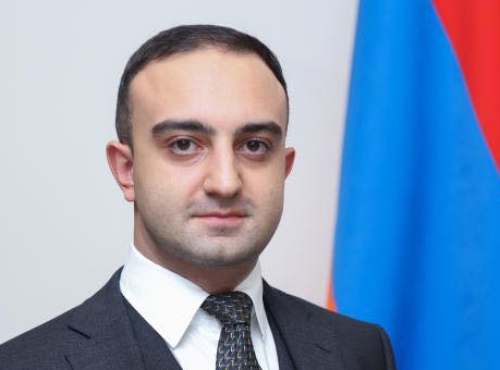








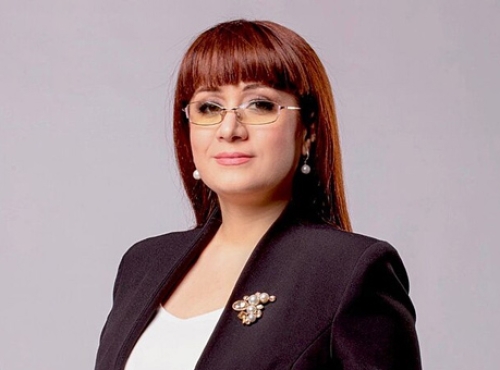


Armenia has never discussed, is not discussing, and will never discuss the “terminology and logic” promoted by Azerbaijan’s President Ilham Aliyev, said Nazeli Baghdasaryan, spokesperson for the Armenian prime minister.
Her remarks followed Aliyev’s claim at an international media forum that Azerbaijani cargo and citizens should not encounter Armenian border services while traversing what he called the “Zangezur corridor.” He further asserted such unrestricted passage was discussed during a meeting with the Armenian prime minister in Abu Dhabi and declared there would be no “operators or leasing” on Azerbaijani territory.
Baghdasaryan denied that any such terms were discussed during or around the July 10 meeting in Abu Dhabi. She stated that Aliyev’s claim “is outside the logic of the discussions” and amounts to a “veiled territorial claim,” contradicting the spirit and content of past negotiations.
Armenia is pursuing its Crossroads of Peace project, which aims to reopen regional transportation in accordance with sovereignty, territorial integrity, and reciprocal arrangements. Armenia expects unobstructed transit through Azerbaijan to Syunik and other regions, and is likewise willing to ensure Azerbaijani transit through Armenian territory.
Prime Minister Nikol Pashinyan reiterated that all individuals and goods entering Armenia—including those in transit—must pass through customs and border control in accordance with international norms. Armenia must be able to track who enters, whether they exit, and what goods are transported through its territory. This oversight is vital to prevent smuggling and mitigate risks, such as the handling of hazardous materials.
There is no scenario, Baghdasaryan said, in which Armenia’s border agencies could be bypassed. Like Azerbaijan, Armenia has international obligations to prevent cross-border crime, which are fulfilled via its border and customs institutions. However, modern solutions are feasible—border checks may be contactless, leveraging biometric passports and digital scanning, a model widely used globally.
All freight must be sealed, and transit fees—differing by mode of transport—must be paid. Armenia’s state budget should benefit from renewed transit flows.
On security, Armenia will safeguard transit routes on its territory, including cargo, vehicles, pipelines, cables, and passengers. Special security units under the National Security Service are being established to reinforce this within the Crossroads of Peace initiative.
As for infrastructure investment, each country determines its model. Pashinyan said that no investment scheme in Armenia can go beyond the country’s sovereignty and jurisdiction.
Commenting on Aliyev’s remarks that Azerbaijan will soon complete its segment of railway up to the Armenian-Iranian border, and that Armenia has made no effort in five years, Baghdasaryan stressed Armenia has made multiple proposals. These include using Armenian locomotives and engineers to link Syunik, western Azerbaijan, and Nakhichevan, under the agreed principles. Azerbaijan has either ignored or rejected these offers.
She clarified that a railway in Syunik would only be built if Azerbaijan agrees, since without that agreement, it would be unusable even for internal freight. Preparatory work is already underway, such as building a new road to Nrnadzor. Armenia remains committed to regional reopening, as reflected in its Crossroads of Peace plan.
Regarding peace talks, Aliyev said Yerevan and Baku are close to signing a deal, but conditioned its pre-signing on Armenia amending its constitution and dissolving the OSCE Minsk Group. Baghdasaryan said such pre-signing is a viable agenda point, with active discussions ongoing.
Pashinyan has repeatedly stated that if Armenia’s Constitutional Court finds the peace deal unconstitutional after signing, he will initiate constitutional reforms. However, no such contradiction currently exists: in September 2024, the Court ruled that Armenia’s Constitution contains no territorial claims against other nations.
According to her, discussions about constitutional reform began back in 2018–2020 and remain a domestic matter unrelated to negotiations with Azerbaijan.
On the issue of prisoners and missing persons, Baghdasaryan confirmed that they are addressed in all negotiation formats, including current talks.