







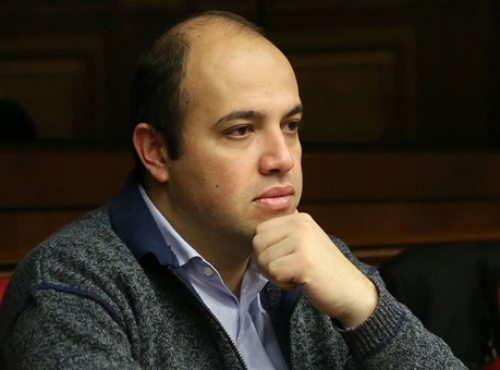


Political analyst Hrant Melik-Shahnazaryan reacted critically to former President Robert Kocharyan’s recent interview, expressing confusion over two of his key claims.
He stated that Kocharyan, a leader of one of Armenia’s major opposition blocs, “essentially considers the issue of surrendering Artsakh and national betrayal closed.”
“Kocharyan claims that the only clause in the notorious November 9 Declaration—which essentially amounts to Armenia’s capitulation—that benefits Azerbaijan is Clause 9, which ensures safe transit between Azerbaijan’s western regions and the Nakhichevan Autonomous Republic.
Apparently, Clause 2, which commits Armenia to returning the Aghdam region to Azerbaijan, and Clause 6, which obliges the Armenian side to cede Kelbajar and Lachin, are not in Azerbaijan’s interests. Nor, presumably, is Clause 7, which allows internally displaced persons and refugees to return to Nagorno-Karabakh and surrounding areas. Let alone the overall content of the declaration, which is nothing short of capitulation,” Melik-Shahnazaryan wrote.
He also took issue with Kocharyan’s repeated mention of the “values of the 2018 revolution,” which Kocharyan said Prime Minister Nikol Pashinyan has since betrayed. “These two claims are, to put it mildly, odd,” the analyst noted.
Still, Melik-Shahnazaryan acknowledged Kocharyan’s candor in asserting that only two major opposition forces currently exist—the Hayastan alliance and a new movement led by businessman Samvel Karapetyan. “At least he was honest about his goals, ambitions, and—pardon the term—dreams,” he added.
“In short, the leader of one of the largest opposition blocs now considers the issues of surrender, betrayal, and national peril closed. New elections, new reality… I wish Kocharyan’s team luck in the 2026 elections.”
He closed with a rhetorical puzzle: “Try solving this equation: Hayastan bloc – ARF = ?”
In the same interview, Kocharyan criticized ongoing discussions around the so-called “Zangezur Corridor,” calling it “a masterpiece of diplomatic failure.”
He said, “This topic should have ended with the handover of Artsakh. Now, Artsakh is gone, Lachin Corridor is gone, yet this issue continues to live on. When a topic lives on by itself, it means you’ve made your territory disputable—other countries are negotiating a corridor through your land, and you’re not even at the table. This is not being at the table—it’s being on the menu.”