







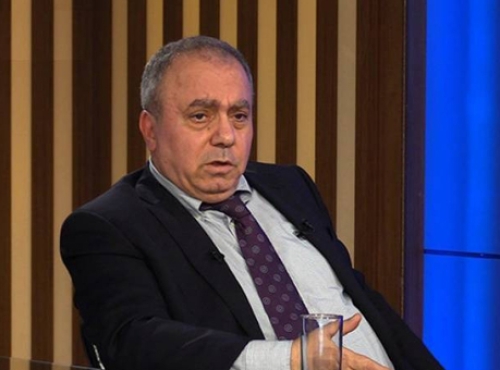


Former Armenian Prime Minister Hrant Bagratyan highlighted the distinction between a corridor and a transit route on his Facebook page, pointing out the political and sovereignty implications of each.
“What is a corridor and what is a transit route? A corridor or, hypothetically, the leasing of a road implies a restriction of sovereignty over the area. Economically speaking, it amounts to a transfer of sovereignty (to a third party), either temporarily or permanently. In such cases, the suzerain (the state owning the territory) loses the right to fully manage, control, and utilize the area,” he wrote.
In contrast, a transit route does not involve sovereignty transfer. According to Bagratyan, the user of the transit route typically pays the suzerain for using the road, and border and customs checkpoints are unavoidable in such cases.
Bagratyan believes the idea of granting Azerbaijan a corridor or route through Armenian territory originated with point 9 of the trilateral statement signed on November 9, 2020.
“The first eight points addressed issues around Artsakh. Point 9 referred to an ‘unimpeded’ road through Armenia (presumably Syunik), connecting Azerbaijan’s eastern and western regions (Nakhichevan). Azerbaijan and Turkey interpreted this as a corridor. Let’s not forget that Prime Minister Pashinyan signed this unusual document.”
Subsequently, debates emerged over what “unimpeded” meant. Russia’s Deputy Prime Minister Alexei Overchuk, involved in these matters, stated three times in 2021–2022 that the road, to be overseen by Russian security forces, would function within Armenia’s sovereignty and territorial integrity. This implied that Armenian authorities would conduct border and customs control.
However, Bagratyan notes that the Russian Foreign Ministry and its spokesperson Maria Zakharova offered more ambiguous interpretations. In 2022, when an Azerbaijani reporter asked when Armenia would open the “promised” corridor, Zakharova timidly replied, “We don’t use the term ‘corridor’”—instead of reprimanding the reporter. According to Bagratyan, this triggered increased anti-Russian rhetoric from Armenian authorities.
In September 2022, Azerbaijani military aggression erupted along Armenia’s borders. U.S. Speaker Nancy Pelosi visited Armenia. By the third week of September, aggression ceased—allegedly due to joint U.S.–Russian efforts. Bagratyan speculates this pause might have followed Pashinyan’s promise to recognize Artsakh as part of Azerbaijan. On October 7, 2022, in Prague, Pashinyan formally recognized Artsakh as Azerbaijani territory. Eight weeks later, Azerbaijan shut down the Lachin corridor. One year after that, Azerbaijani offensives resulted in the depopulation of Artsakh.
Bagratyan concluded that the discussion is far from over.
During a recent international media forum, President Ilham Aliyev said that “Azerbaijani cargo and citizens should not encounter Armenian border services or anyone else” and framed the “Zangezur Corridor” as an uninterrupted, secure passage between parts of Azerbaijan. He claimed this was also raised in a meeting with Armenia’s Prime Minister in Abu Dhabi. He also emphasized that no “operator, lease, or rent” would exist on Azerbaijani territory.
In response, Armenian Prime Minister’s spokesperson Nazeli Baghdasaryan stressed that Armenia has never discussed, is not discussing, and will not discuss the terminology used by Azerbaijan’s President or its implied logic. She also rejected Aliyev’s statement that Azerbaijanis should avoid Armenian border guards as inconsistent with the ongoing negotiations.