







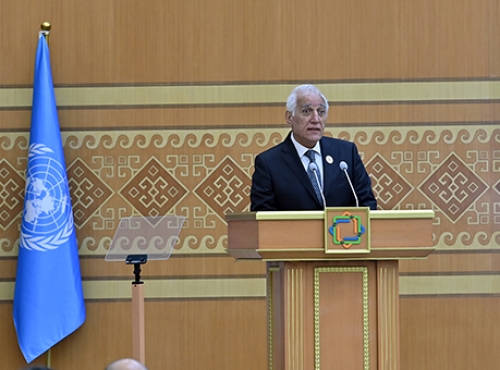


Armenian President Vahagn Khachaturyan addressed the official opening of the Third United Nations Conference on Landlocked Developing Countries in the city of Turkmenbashi, where he presented the potential of the "Crossroads of Peace" initiative.
He emphasized that the initiative seeks to establish practical arrangements based on shared interests in trade, transport, energy, and tourism, turning its vision into reality.
"Access to global markets is vital to ensure inclusive and sustainable development. In today’s interconnected world, the cross-border flow of goods, services, and people is a powerful driver of collective prosperity. Yet landlocked developing countries continue to face major challenges due to geographic constraints that often hinder their full participation in global trade, economic diversification, and investment inflows—slowing our collective progress toward achieving the Sustainable Development Goals.
To overcome these obstacles and transform the lives and economies of landlocked developing countries, we now have a clear, forward-looking roadmap. The 'Roadmap for the Landlocked Countries' is a comprehensive document that outlines firm steps, commitments, and outcomes agreed upon by all stakeholders, particularly aimed at addressing the socio-economic consequences of emerging global threats. The new Roadmap’s five priority areas build upon the Vienna Programme of Action and directly respond to the most pressing challenges faced by landlocked developing countries.
This Roadmap can serve as a guide for enhancing cooperation among landlocked developing countries, transit countries, the United Nations and its agencies, as well as international development organizations and financial institutions—helping us achieve rapid and significant progress on shared priorities," Khachaturyan said.
He added that translating the ambitions of the new Roadmap into concrete results poses a serious challenge, especially given the lack of funding for transport infrastructure.
"It’s evident that landlocked developing countries cannot do this alone. We need strengthened regional cooperation between landlocked and transit states. Artificial and incentive-driven barriers to the free movement of people, goods, and services must be eliminated. This is not only a practical necessity but also essential to safeguarding economic and social rights, the right to development, and inclusive regional and global connectivity.
We value meaningful support from development partners to increase investments in cross-border infrastructure, enabling faster and more efficient trade.
It’s also imperative to ensure that landlocked developing countries are fully included in the global digital and green transformation to prevent their further marginalization in the global economy.
We must also enhance resilience in the face of climate change and biodiversity loss. As the next host and chair of the COP17 conference on biodiversity, Armenia is committed to advancing this critical agenda and ensuring that landlocked developing countries are connected and able to benefit fully from their rich biodiversity resources.
I represent a country that has faced the consequences of geographic limitations and a complex geopolitical environment for over three decades. With closed borders with two neighbors and no direct access to oceans or seas, Armenia faces unique challenges in trade, transport, and freight. The government fully understands the critical importance of inclusive connectivity, open borders, and reliable infrastructure to integrate into global markets.
With this understanding, the Government of Armenia has developed the 'Crossroads of Peace' initiative, demonstrating our country’s commitment to regional peace and cooperation, while promoting inclusive connectivity at both regional and global levels.
The 'Crossroads of Peace' project has the potential to make our economies more prosperous and resilient. By aligning economic interests with the long-awaited goals of peace and stability, the project aims to establish practical trade arrangements grounded in shared interests in trade, transport, energy, and tourism—bringing vision into reality," the Armenian president stated.
The government has proposed the 'Crossroads of Peace' project, focused on restoring and building transportation and communication links among Armenia, Turkey, Azerbaijan, and Iran, including roads, railways, pipelines, cables, and power lines. All infrastructure will operate under the sovereignty and jurisdiction of the countries they pass through.