










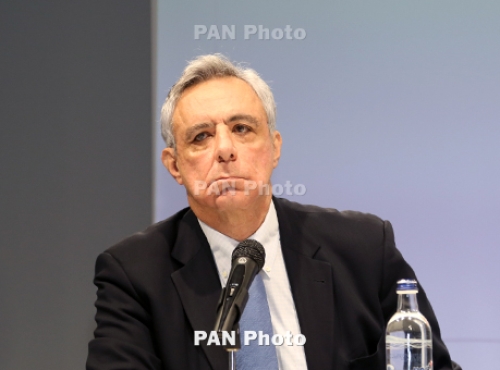


Former Armenian Foreign Minister Vartan Oskanian has sent a letter to foreign ambassadors accredited in Armenia, as well as to leading international human rights organizations and institutions, urging them to respond to the presence of political prisoners in Armenia and to raise the issue with the country’s authorities through clear and public statements. He posted the letter on his Facebook page.
Describing the situation regarding political prisoners as alarming, Oskanian warned that continued praise of Armenia’s so-called “democratic stability” could lead to “further repression.”
“More than two dozen individuals—including members of parliament, opposition leaders, civil society figures, businessmen, and two senior clergy of the Armenian Apostolic Church—are being held not for any proven crimes, but for expressing disagreement with government policies. Their prolonged pretrial detention, often lacking convincing legal grounds, is a blatant violation of both Armenian law and international human rights standards,” the letter reads.
Oskanian stressed that these are not isolated incidents, but signs of a deliberate and systemic campaign of political persecution in Armenia. He noted the judiciary is increasingly influenced by the executive branch, and that institutions once supported by the West to promote democracy now act against dissenters.
He also emphasized that, despite formal freedoms, the media is subject to political and financial pressure, while independent civil society is shrinking. Most concerning, he said, is the campaign against the Armenian Apostolic Church—marked by arrests and smear attacks—which threatens the foundations of national identity.
“Despite all this, many of you have chosen silence or strategic ambiguity over taking a principled stand. Continued public praise of Armenia’s supposed ‘democratic resilience’ can only encourage further repression… The time to act is now, before an entire generation loses hope in Armenia ever becoming the democracy it once aspired to be. I urge you not to remain silent,” Oskanian concluded.
Earlier, Oskanian had also proposed creating a special mechanism to amplify the voices of those imprisoned and unable to speak for themselves.