







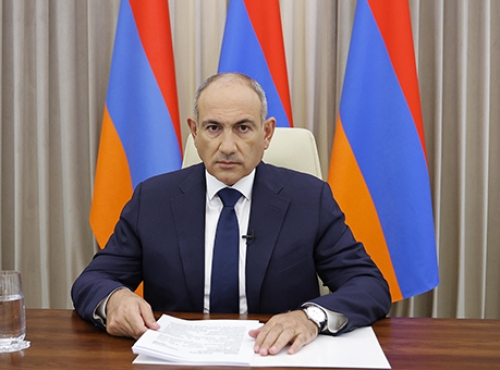


Prime Minister Nikol Pashinyan, in a public address, stated that under the new logic for achieving peace, both Armenian territories under Azerbaijani control and Azerbaijani territories under Armenian control must be acknowledged.
He made this point in response to concerns that the peace agreement preliminarily signed in Washington omits provisions on more than 200 square kilometers of Armenian land under Azerbaijani occupation. Pashinyan said that both countries have recognized each other’s territorial integrity based on the 1991 Alma-Ata Declaration.
“This reality must be addressed through border delimitation. But the logic of peace, this new logic, is that if we acknowledge that parts of Armenian sovereign territory are under Azerbaijani control, we must also recognize that parts of Azerbaijani sovereign territory are under our control. This mutual issue must be resolved during the delimitation process,” the Prime Minister said.
Opposition critics argue that the peace process has failed, citing the dissolution of the OSCE Minsk Group without addressing the return of the people of Nagorno-Karabakh. Pashinyan reminded the public that he had already declared months ago that the Karabakh Movement must end, and encouraged citizens to stage a revolution if they disagreed.
“You, the people, dear citizens, did not rise up because you understood—just as I did—that peace is impossible without resolving the Karabakh issue. Certain forces merely used it as a tool to prevent Armenia’s independence, sovereignty, and state development,” he said.
Pashinyan described the return of those displaced from Nagorno-Karabakh as unrealistic. He warned that pushing such an agenda “could disrupt peace between Armenia and Azerbaijan.”
“Efforts to raise this issue bilaterally will achieve nothing for the refugees and will only become a new source of tension between states. I’ve shared this view with official Baku and confirmed that yes, it’s a dangerous and harmful topic for the new peace. Anyone opposing this strategy, willingly or not, falls into the logic of reigniting conflict,” he said.
He proposed that displaced Karabakh Armenians settle in Armenia with full citizenship status.
Pashinyan also addressed the issue of prisoners of war, noting that the peace agreement does not include specific provisions regarding detainees, as Yerevan preferred not to tie the matter to the document’s signing. He assured that active diplomatic efforts are underway to resolve the issue as soon as possible.
“Enormous diplomatic work is ongoing to resolve this matter swiftly, as you have recently seen and witnessed,” said Pashinyan.
The Prime Minister also responded to concerns over regional unblocking, reiterating that the conditions granted to Baku will equally apply to Armenia. According to the declaration, Azerbaijan will receive unobstructed access to Nakhchivan, and Armenia will receive reciprocal transit opportunities. However, border delimitation must come first.
“This means that before any communication routes are restored or built, the state border between Armenia and Azerbaijan must be clarified, delimited, and demarcated. And that border requires standard infrastructure—border guards, customs points, and so on. Separately, we have previously expressed our willingness to simplify border crossings, and this will be a subject of detailed discussion,” Pashinyan said.
He added that he has no concerns in this area, emphasizing that a consensus on core principles has already been reached. He assured that international partners’ concerns about unblocking have been resolved.
Finally, Pashinyan announced that since August 8, a new reality has emerged in the South Caucasus and that peace has been established between Armenia and Azerbaijan.
Meanwhile, Baku continues to insist that Armenia complete its “homework” by amending its Constitution.