







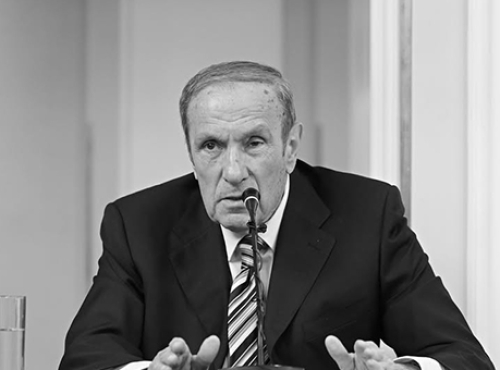


Responding to a question on how he envisions a resolution to the so-called “Zangezur corridor” issue, Armenia’s first president Levon Ter-Petrosyan stated that he would avoid using the term “Zangezur corridor,” as it triggers concern among active segments of Armenian society, ilur.am reports.
“Therefore, I believe it’s more appropriate to refer to it as the ‘Zangezur transport hub’ instead,” he said.
Ter-Petrosyan stressed that control over the Zangezur transport hub must be exercised exclusively by Armenia, as a sovereign right. As for the political and economic interests of other states, he believes Armenia is capable—under international law—of ensuring uninterrupted access and operations.
He emphasized that Armenia, willingly or not, expects active cooperation from its strategic partners—Russia, the U.S., and Iran—even amid clear tensions between them.
“Conflicts between major powers are generally easier to resolve than those between smaller countries, due to the maturity of global powers. This is evidenced by historical precedents like the resolution of the Cuban Missile Crisis (1962), the Damansky Island conflict (1969), various arms reduction treaties signed amidst Cold War rivalries, and coordinated solutions during proxy wars,” Ter-Petrosyan explained.
In Washington, the leaders of Armenia, Azerbaijan, and the United States—Nikol Pashinyan, Ilham Aliyev, and Donald Trump—officially agreed to launch the Trump Route.
“The route will allow Azerbaijan to access Nakhichevan while fully respecting Armenia’s sovereignty. Armenia will also establish an exclusive partnership with the U.S. to develop this transit line, with an initial term of up to 99 years and the possibility of another 99-year extension. Major infrastructure development is expected, and American companies are eager to enter and invest heavily, which will bring economic benefits to all three countries,” Trump said.