



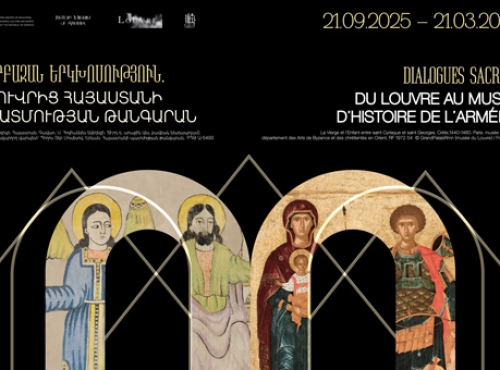


On September 21, Armenia’s Independence Day, the History Museum of Armenia will open a landmark exhibition featuring 16 outstanding oriental Christian works from the Louvre’s collection, Armenpress reported. The pieces will be displayed in dialogue with selections from the Yerevan museum’s own holdings.
The curators are Davit Poghosyan, Nzhdeh Yeranyan, Sona Hovsepyan, Maximilien Durand, and Camille Chenet.
The exhibits span a wide geography — from Bulgaria to Egypt, Crete to Syria — and date from the 4th to the 19th centuries. Items include glass and woodwork, khachkars and architectural fragments, jewelry, liturgical garments, curtains, vessels, and icons.
Highlights from the Louvre include: a textile with the Prophet Jonah (4th–5th c., Egypt), a sculpture of a cross and fish (5th–7th c., Egypt), a reliquary cabinet (5th c., Italy), the Gane reliquary box (6th–7th c., Byzantine Empire), a silver bracelet with reliefs (12th–13th c., Byzantine Empire), an icon of the Virgin (15th c., Crete), and a Crucifixion icon (19th c., Jerusalem).
These will be paired with Armenian artifacts such as the Dvin winged cross (7th c.), wooden capitals from Sevan’s Holy Apostles Church (9th c.), a carved wooden door (15th c.), an incense burner from Ani (13th c.), the altar cross of Baghes’ St. John Monastery (1770), and a 19th-century curtain from Gavar’s St. John Church. A reliquary of St. Bartholomew the Apostle from Etchmiadzin will also be presented.
The exhibition aims to showcase the shared heritage of Armenia and the Christian East, highlighting exchanges of techniques, iconography, and motifs, as well as links with the Roman Empire and the Islamic world.
The project stems from a memorandum signed last year between the History Museum of Armenia and the Louvre, marking a new stage of cooperation. Opening on Independence Day underlines Armenia’s historic role as the first Christian state.
The exhibition will run until March 21, 2026, with support from Armenia’s Ministry of Education, Science, Culture and Sports.