





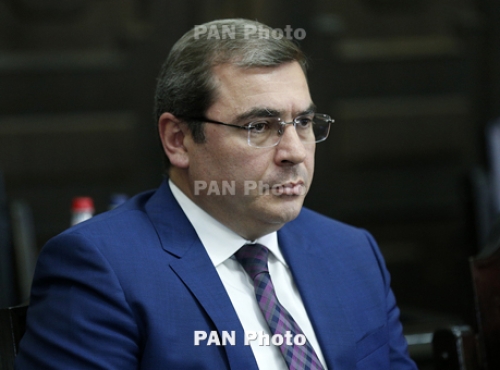


Former chairman of Armenia’s State Revenue Committee Davit Ananyan commented on discussions around opening the Armenia-Turkey border, stressing the risks of vulnerability and dependence. He shared his analysis on Facebook.
Ananyan argued that a deeper look shows the situation is not as simple or promising as some portray.
First, transport infrastructure. Crossing into Turkey from Armenia, the roads and railway links to Turkey’s main logistical hubs are either absent or in poor condition. He noted that Turkey would require major investment to make those routes suitable for heavy international traffic, and even with political will, this process would take time.
Even if crossings at Margara or Akhurik are opened, and Armenia gains access to Turkey’s road network leading to major Mediterranean ports such as Mersin and Derince, their distance (850 km and 950 km, respectively) would make freight transport more expensive, not cheaper, due to long distances and additional costs.
Second, economic balance. Turkey’s economy is many times larger, while Armenia’s remains fragile. The immediate consequence of opening the border would likely be an intensive inflow of Turkish goods into Armenia, overwhelming local industries already struggling with competitiveness.
Third, customs restrictions. As a member of the Eurasian Economic Union (EAEU), Armenia cannot independently apply protective tariffs or restrictions. Since tariff policies are decided collectively by consensus within the EAEU, Armenia would find it nearly impossible to shield local producers through customs duties or trade barriers.
Ananyan concluded that while border opening might carry symbolic or political weight, economically it poses more risks of vulnerability and dependence than opportunities. Without a serious strategic plan beyond symbolic peace gestures, claims of “major economic benefits” are unrealistic.
Turkish President Recep Tayyip Erdoğan recently stated at the UN General Assembly that normalization between Ankara and Yerevan is ongoing.