








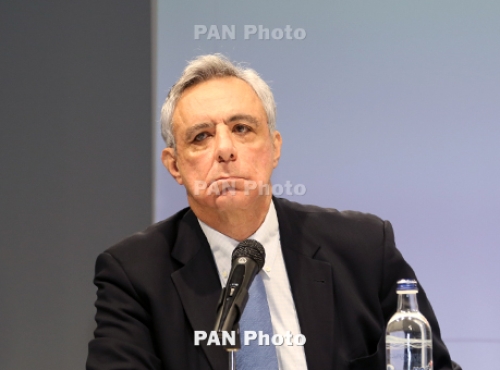


Former Armenian Foreign Minister Vartan Oskanian outlined two major developments regarding the right of return for Armenians displaced from Nagorno-Karabakh, in a Facebook post.
“Two years have passed since Azerbaijan’s attack on Artsakh, which forced the entire Armenian population to flee. And yet, the right of return remains firmly on the international agenda,” he wrote.
First, Oskanian cited a U.S. State Department response acknowledging three key priorities for a fair settlement between Armenia and Azerbaijan:
- The right of return for Armenians of Artsakh
- The release of Armenian detainees held in Azerbaijan
- The protection of Armenian Christian cultural heritage
U.S. Congressman Frank Pallone announced on platform X that the State Department responded to a letter signed by nearly 90 members of Congress, pledging to actively pursue these priorities. Oskanian credited this shift to persistent efforts by the Armenian National Committee of America (ANCA), the Committee for the Protection of the Rights of the People of Artsakh, and the broader Armenian-American community. “Amid Baku’s denial and Yerevan’s silence, the U.S. has now officially spoken. This is no longer just about recognizing principles—it’s about implementing them,” he added.
Second, in Geneva, Swiss MPs Erich Vontobel and Nicolas Walder participated in a side event during the UN Human Rights Council session, organized by Christian Solidarity International with support from the same Artsakh committee. The aim was to promote a Swiss peace initiative that mandates Switzerland to organize a peace forum between Baku and representatives of Artsakh’s displaced population, focused on a safe and collective return. Former Artsakh Ombudsman Artak Beglaryan and Dr. Paul Williams, a Washington-based international law expert and head of PILPG, also spoke. Their message was clear: the rights of the people of Artsakh—not geopolitical interests—must guide any settlement.
Oskanian noted that these are not isolated cases. The International Court of Justice has already ordered Azerbaijan to allow the safe return of Armenians. The European Parliament reaffirmed the principle of return in two resolutions. France’s Parliament issued similar statements twice, and Belgium and Switzerland have joined that position, the latter through a unique national initiative.
“These are not coincidences,” he emphasized. “On both sides of the Atlantic, lawmakers, diplomats, and civil society leaders are confirming a simple truth: no peace is sustainable if built on ethnic cleansing, no treaty is just if it denies tens of thousands their right to return, and no international order can be considered legitimate if it remains silent on illegal detention and cultural erasure.”
Oskanian sharply criticized Azerbaijan’s denial and Prime Minister Nikol Pashinyan’s silence, saying the latter has “chosen to shut the door on Artsakh rather than defend the rights of his people.” But, he insisted, “this resistance—from Baku or Yerevan—cannot erase the emerging global consensus. The right of return remains on the international agenda.”
On September 19, 2023, Azerbaijan launched a full-scale attack on Artsakh, subjecting the region to heavy shelling. On September 20, Artsakh authorities agreed to a ceasefire mediated by Russian peacekeepers, accepting Baku’s terms, including disarmament and the dissolution of the Republic of Artsakh. From September 24, over 100,000 Armenians were forcibly displaced to Armenia. By some estimates, only around 20 Armenians remain in Artsakh. On September 28, President Samvel Shahramanyan signed a decree dissolving the republic effective January 1, 2024. On October 19, he issued a second decree nullifying that dissolution announcement.