






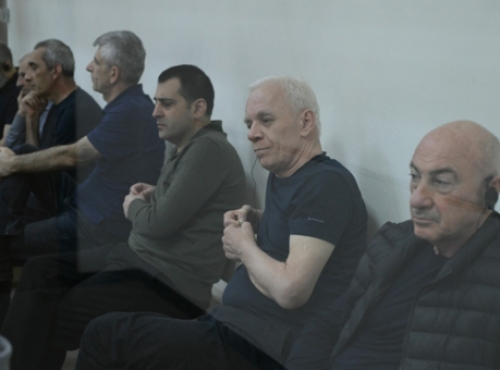


During a discussion on the rights of Armenian captives and hostages held in Baku, Siranush Sahakyan, president of the International Comparative Law Center, commented on motions filed by Davit Manukyan, Davit Babayan, and Ruben Vardanyan. These included proposals to summon Prime Minister Nikol Pashinyan, Foreign Minister Ararat Mirzoyan, OSCE Minsk Group members, and Red Cross representatives as witnesses.
“I see a tactical move here. I don’t think they expected the motions to be accepted or actual questioning to take place,” Sahakyan said, Panorama.am reported. She noted the motions carried a largely rhetorical purpose.
According to Sahakyan, the defendants are accused of actions connected only with holding office in Artsakh’s government, while their official activities are being framed as terrorism or unlawful armed group activity.
“The underlying question is this: if no international action condemned Artsakh’s self-determination as illegal, and instead a legitimate mechanism was created for conflict resolution, how can official acts ever be considered crimes? If they are crimes, then there must be accomplices,” she stressed.
She argued that, by this reasoning, countless officials worldwide who met or negotiated with Artsakh’s leaders, from representatives who held talks with Bako Sahakyan to the OSCE Minsk Group co-chairs, could be labeled criminals.
“Any state representative who negotiated with Artsakh’s presidents, such as Bako Sahakyan, would be considered an accomplice. The Minsk Group, which discussed solutions with Artsakh’s administration, would be criminal. And since countries including the U.S. provided financial assistance to Artsakh, does that mean these states funded terrorism?” Sahakyan asked.
In this context, she said, the true meaning of the motions was to send a message to the international community: the process of self-determination in Artsakh cannot be treated as a crime.
“The content of these motions was simple, i.e., to show the world that the right to self-determination cannot be criminalized. If it is, then efforts must be made to identify all supposed accomplices,” Sahakyan concluded.
On September 19, 2023, Azerbaijan launched a large-scale attack on Artsakh, followed by mass displacement. Over 100,000 Armenians were forcibly driven to Armenia. On January 1, 2024, the Nagorno-Karabakh Republic was officially dissolved, though later disputed by a presidential decree.