









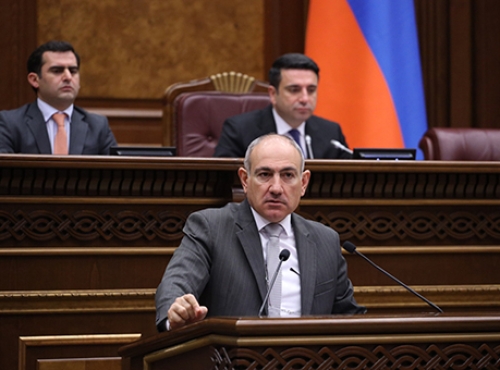


During a parliamentary Q&A session, Armenian Prime Minister Nikol Pashinyan stated that the term “Zangezur Corridor” refers to the Horadiz-Zangilan road in Azerbaijan, which may extend to a point near Armenia’s border but does not cross into Armenian territory, Armenpress reports.
“In my understanding, when Azerbaijan says ‘Zangezur Corridor,’ they mean the Horadiz-Zangilan road. Let them call it that if they want. I say this: there is no such thing in the Republic of Armenia. And I can prove it—not only with my words, but with documents signed by the President of Azerbaijan as well,” Pashinyan said.
He said that Armenia should not be concerned with what names Azerbaijan chooses to give its internal infrastructure. “They might decide to name it ‘Albert Einstein.’ Let them. It has nothing to do with our sovereign territory. I have signed documents that are public. We have roads named ‘Trump’s Route’ and the ‘Crossroads of Peace’ within Armenia.”
Discussing Armenia’s “Crossroads of Peace” initiative, Pashinyan highlighted that Armenia has no obligation to consult others when naming infrastructure projects on its own soil. “We don’t need anyone’s approval. The officially agreed name is the TRIPP route.”
He reiterated that the so-called “Zangezur Corridor” refers solely to infrastructure within Azerbaijan. “Azerbaijan is free to name any road as it pleases within its own borders,” he added.
Pashinyan affirmed that Armenia’s approach to regional connectivity remains unchanged and aligns with prior agreements, including the commitments signed on August 8, 2025, in Washington. “My position has not changed, neither hardened or weakened. What was agreed in Washington is our policy and will, and we are committed to implementing it.”
He also addressed concerns about the term “Zangezur Corridor,” noting it does not appear in any signed or pre-signed documents between Armenia and Azerbaijan. “Why is this term circulating? It is not part of any document. If Azerbaijan wants to call something that way, it is their business. Armenia names its routes; Azerbaijan names its own. We have recognized each other’s sovereignty, territorial integrity, and inviolability of borders.”
Pashinyan emphasized Armenia’s readiness to begin practical planning and implementation of key infrastructure projects without politicization. “We are ready to start designing pipelines, power lines, and railways. Simplifications for customs and border control will follow the five principles: sovereignty, territorial integrity, border inviolability, jurisdiction, and reciprocity.”
In conclusion, Pashinyan said, “Why create disputes over terminology? Let’s focus on implementation. We are actively working in this direction.”
Earlier, at the UN General Assembly’s 80th session, Pashinyan responded to Azerbaijani President Ilham Aliyev’s rhetoric, stating that the use of the term ‘Zangezur Corridor’ is perceived as a territorial claim against Armenia. While a peace declaration was signed in Washington, significant work remains, and Aliyev’s language contradicts peace-building efforts.