





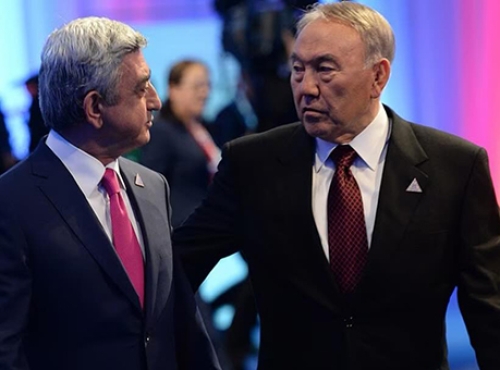


Samvel Farmanyan, former press secretary to Armenia’s third president Serzh Sargsyan, has revealed new details about the well-known 2014 incident in Astana where Kazakh President Nursultan Nazarbayev publicly raised the issue of Nagorno-Karabakh in the context of Armenia's accession to the Eurasian Economic Union (EAEU).
In a Facebook post, Farmanyan disclosed that during the EAEU leaders’ summit, Nazarbayev stated, in the presence of media, that Azerbaijani President Ilham Aliyev had raised concerns about Armenia joining the EAEU with Nagorno-Karabakh. Nazarbayev emphasized that Armenia must join within its internationally recognized borders and cited a similar precedent during Armenia’s accession to the World Trade Organization (WTO).
Sargsyan’s decision not to respond triggered harsh public criticism at the time.
Farmanyan now explains that Armenia’s leadership had been warned in advance, with help from international partners, that Nazarbayev would raise this issue at the summit, on Aliyev’s behalf. Despite this, Sargsyan remained silent, a move Farmanyan says was driven by two strategic reasons:
- The EAEU decision had already been negotiated with Russian President Vladimir Putin, the key stakeholder. Challenging Nazarbayev or Lukashenko publicly, even for domestic popularity, would not have helped Armenia’s bid and could have jeopardized it — since EAEU decisions are made by consensus.
- Nazarbayev reportedly had in his folder a copy of a 2002 letter sent by Armenia to the WTO during its accession, in which the Armenian government confirmed it was joining within its internationally recognized borders, a concession reportedly made under Azerbaijani pressure. This letter, Farmanyan says, was an official assurance sent, likely from Armenia’s foreign ministry, as part of WTO accession negotiations.
Sargsyan, knowing this document could be pulled out and used against Armenia in front of the press, chose silence to protect the country’s long-term interests and avoid reigniting diplomatic or internal political damage, particularly to the reputation of former President Robert Kocharyan, under whose tenure the letter was sent.
“This is the truth,” Farmanyan said, adding that the incident reflects a broader dilemma in politics: the choice between state interests and personal reputation.
“P.S. One journalist told me this could be a great investigative report. I agree, at least for the historical record. But it’s also a reason to reflect on the eternal dilemma in politics between national interest, personal honor, moral integrity, and public ingratitude,” Farmanyan concluded.