






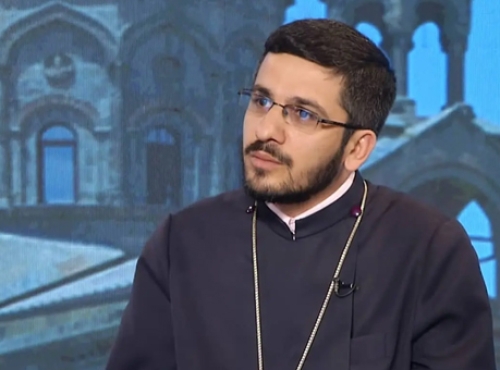


Today, Father Ruben Zargaryan of the Mother See of Holy Etchmiadzin responded to recent actions taken against clergy, urging spiritual fathers not to fear persecution.
He emphasized that “the priestly calling is the way of the Cross, not of adaptation.” He addressed his fellow clergy: “Dear spiritual fathers, let us not fear. If we are rejected for Christ’s name, then we are on the right path. Let our weapon be the Cross, our shield faith, and our victory love and unity.”
He recalled the exile and shootings of Armenian clergy under the Bolshevik regime—events read about in books, once unimaginable. He said the actors may have changed, but the image and essence remain.
“At a time when our Holy Church again faces winds of persecution, even from our own authorities, we are called to remember the Lord’s words, which never lose their strength: ‘Blessed are you when they revile and persecute you, and say all kinds of evil against you falsely for My sake. Rejoice and be exceedingly glad, for great is your reward in heaven’ (Matthew 5:11–12).”
Christ’s Church, of which the Armenian Church is a full part, has never lived in unrest-free times. It was born through persecutions by the power of the Holy Spirit. The world that rejected its Savior cannot embrace His body —the Church. History testifies that the Church stands on the Cross yet does not sink.
In the early centuries, when Christians were persecuted, they did not panic, despair, or flee. They met clandestinely, prayed, and eagerly baptized new believers. They knew that truth cannot be imprisoned by chains. As the Apostle Paul says: “I suffer hardship as a prisoner, but the word of God is not bound” (2 Timothy 2:9).
Today, it may seem new that secular authorities unleash persecution against Armenian clergy through unlawful means. But no — this is the same trial that has always accompanied us on our path of faith and mission. Remember the exile and executions of Armenian clergy under the Bolsheviks—read about in books, once unimaginable. Today, the roles have changed, but not the image or essence: democratic facades cloak the same Bolsheviks as neo‑Bolsheviks, perhaps descendants of popes who betrayed or destroyed the church. But as gold is refined by fire, so the Church is purified and strengthened through trials,” he said.
He noted that in this darkness, they are called to be light-bearers and hope-inspirers, even by personal example in persecution.
“As clergy of the Armenian Church, our calling is not to be servants seeking worldly respect, but witnesses to the Lord. The priestly calling is the way of the Cross—not adaptation,” he wrote.
He added that the Church is not a human institution but the Body of God, established by the grace of the Holy Spirit.
“No law or authority, no betrayal or hatred, can overthrow what Christ founded by His blood, ‘that even death itself should not prevail’” (Matthew 16:18).
“Therefore, dear spiritual fathers, let us not fear. If we are rejected for Christ’s name, then we are on the right path. Let our weapon be the Cross, our shield faith, and our victory love and unity.
In these days, let us strengthen our prayer, offer the Divine Liturgy with greater holiness, and pass on to our faithful not fear, but courage.”
On October 15, from early morning, the Investigative Committee, escorted by the National Security Service, conducted searches in the Aragatsotn diocesan headquarters and in homes of clergy. Following that, dozens of clergy, including the diocesan primate Bishop Mkrtich Proshyan and secular employees, were taken in by the Investigative Committee. By court decisions, Bishop Mkrtich Proshyan was arrested for two months, and Father Garekin Arsenyan, spiritual pastor of the Holy Gevorg Church in Mughni and chancellor of the Aragatsotn Diocese, for one month. The rest have witness status. The Investigative Committee reported that a public criminal case has been initiated against the diocesan primate under two articles of the RA Criminal Code: misuse of official position to obstruct the exercise of electoral rights, and coercing participation in gatherings by use of authority or official powers.