





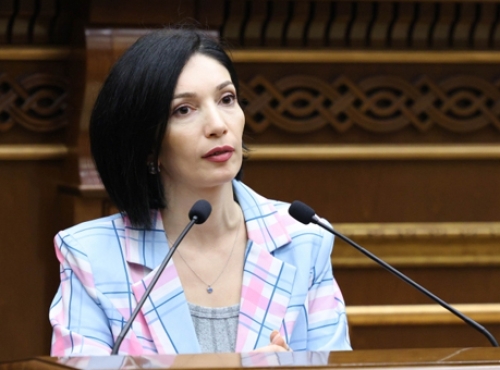


The ruling “Civil Contract” faction has proposed reducing the minimum number of public broadcasters from three to two. The amendments to the Law on Audiovisual Media were introduced in parliament by MP Taguhi Ghazaryan of the ruling bloc.
At the same time, she clarified that lowering the minimum threshold does not mean public broadcasters cannot exceed two. Ghazaryan reminded lawmakers that currently, five broadcasters, including both television and radio, are publicly funded, Sputnik Armenia reports.
“Previously, the state made non-competitive procurements worth about AMD 3 billion from a single entity—Shoghakat LLC—over the years,” she noted, adding that the funds could be spent more efficiently. “We believe this money could be used more effectively, especially since the Public Media Environment Foundation will distribute resources for educational and cultural content to all TV channels on the multiplex. That means all stations will have equal competitive access to public funding,” she explained.
Independent MP Gegham Nazaryan pointed out growing public concern that the proposed bill is aimed at shutting down Shoghakat TV.
“Please clarify your position on this concern,” he urged.
The ruling MP responded that this was not merely a concern or opinion—“we have openly stated this is our goal.”
“Yes, the initiative addresses issues related to Shoghakat LLC,” Ghazaryan confirmed. “Over the years, AMD 3 billion was allocated without competition to a single organization. I think both the opposition and civil society would do better to highlight this inefficient spending, including during the past seven years of our administration.”
Gegham Nazaryan argued that discovering ineffective use of funds—say, at the Matenadaran (the Institute of Ancient Manuscripts)—does not justify shutting it down. He urged a reversal of the decision.
Opposition “Armenia” faction MP Lilit Galstyan advised the bill’s sponsor not to make accusations of misuse “based on gut feeling.”
Responding to the opposition’s criticism, Ghazaryan said she would not provide a detailed justification, noting that the opposition would vote against the bill regardless.
“You just want to have a national TV broadcaster that is required to air cultural and educational content, but also broadcasts live marches of your prime ministerial candidate, Davit Hambardzumyan,” she concluded.
The bill's explanatory note states that the current system leads to issues such as complex resource allocation, content duplication, low viewership of educational and cultural programs, and burdensome management and operations.