








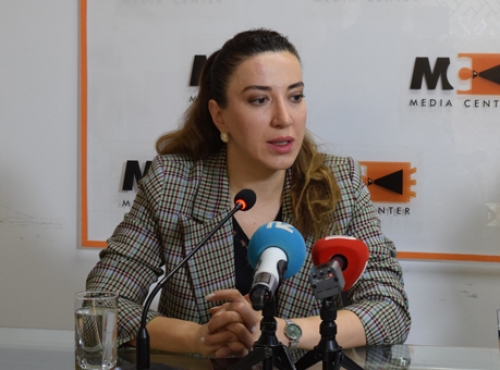


Siranush Sahakyan, president of the Center for International and Comparative Law, stated that the fate of the former military and political leadership of Artsakh and other Armenian captives held illegally in Baku depends not so much on legal decisions, but on political and diplomatic solutions. The comments were reported by Sputnik Armenia.
On October 31, court hearings concluded in Baku involving several former Artsakh leaders (except Ruben Vardanyan) and some prisoners. Prosecutors are expected to present their indictments on November 3.
“Everything indicates that this is a political process. Even if courts issue rulings, those too are political in nature. The courts are merely used as tools. The goal is not justice but to turn the courts into a political mechanism,” Sahakyan emphasized.
According to her, if international partners engage in the peace process and a political path to the captives’ release becomes possible, Azerbaijani court rulings will not pose an obstacle.
Sahakyan believes Azerbaijani authorities aim to manufacture legal justifications to detain captives and control their fate arbitrarily.
She pointed to past cases in which Armenian POWs sentenced to various prison terms were returned to Armenia through political agreements and mutual concessions.
“In those cases, Azerbaijani court rulings did not serve as a barrier. Through the application of a transfer mechanism, without serving sentences, Armenian prisoners of war were returned to Armenia. Similarly, Azerbaijani offenders were sent back to Azerbaijan. In both countries, repatriated individuals did not serve their sentences. This proves that political decisions were decisive,” she explained.
At the same time, she stressed that from a legal standpoint, numerous violations have been documented, including breaches of multilateral international agreements to which both Armenia and Azerbaijan are parties.
Sahakyan said Armenia’s main objective should be to neutralize the impact of the upcoming Baku court rulings in international forums.
“It was never possible to prevent these trials from the outset, since the Armenian nationals ended up under Azerbaijani sovereignty involuntarily, and it was evident that Azerbaijani authorities would pursue their intentions fully. In this context, the best legal outcome would be for international courts to declare that the minimum standards for a fair trial were not met, rendering the verdicts illegitimate,” Sahakyan stated.
She also underscored the importance of diplomatic and international legal documentation as tools to nullify the legal-political effects of illegal rulings.
Sahakyan added that in Armenian-Azerbaijani negotiations, there may be discussions about extraditing those convicted in Baku to serve their sentences in Armenia. However, she warned against such a scenario.
“This is unacceptable and could set a dangerous precedent. I can only note that in previous repatriation cases, such a precedent does not exist. All detainees were released, and the transfer-for-sentencing mechanism has not functioned in Armenian-Azerbaijani relations,” she stressed.
She is convinced that during the November 3 court session, Azerbaijani prosecutors will seek the maximum penalties for the captives. She noted the speed of the proceedings, suggesting insufficient time was allowed for proper preparation.
“This shows the indictments were likely prepared well in advance. The courtroom hearings, the questioning of assigned witnesses or victims, had no real effect on shaping the indictments. I believe these speeches were drafted within Azerbaijan’s special services and approved by the presidential administration, and they will be reflected in the final court rulings,” she said.
Since January 17, a trial has been underway in Azerbaijan concerning the former political-military leadership of Artsakh, including former presidents Arkadi Ghukasyan, Bako Sahakyan, and Arayik Harutyunyan; former defense minister Levon Mnatsakanyan; former foreign minister Davit Babayan; and other ex-officials. The case involving former state minister and philanthropist Ruben Vardanyan is being handled separately.