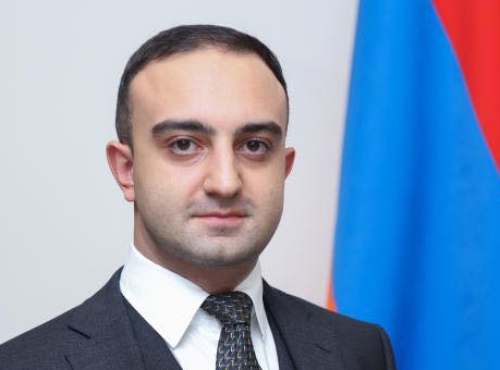









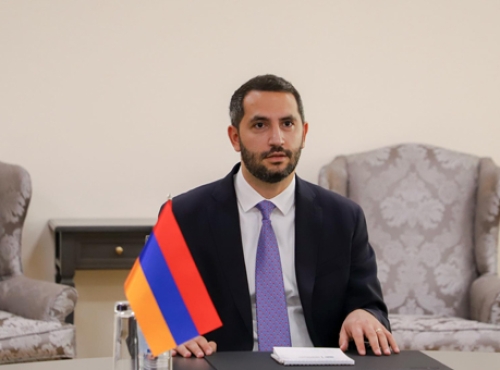


Armenian National Assembly Deputy Speaker Ruben Rubinyan has described Azerbaijani President Ilham Aliyev’s recent comments on toponyms, specifically denying the existence of Lake Sevan and referring to it as “Goycha”, as counterproductive.
Speaking to reporters in parliament, Rubinyan said that although Azerbaijan’s rhetoric has shifted slightly since August 8, statements like Aliyev’s remain unconstructive. “If we go backwards, looking at toponyms, we won’t find anything advantageous for us. But we shouldn’t go back; we should move forward. That’s how we preserve and strengthen peace,” he told Pastinfo.
Rubinyan shared an interaction he had on social media, where a user asked him whether such statements reflected the current state of peace. He replied, “No, that’s not peace. Peace is when Russian wheat is imported to Armenia via rail through Azerbaijani territory, which is exactly what happened yesterday. This is a historic moment. The last time something like this happened was in 1991–92, before the war escalated. It’s the first time that anything is being imported to Armenia by rail from Russia and Kazakhstan.”
He emphasized that this marks a precedent: Armenia now has a railway-based economic connection with a country other than Georgia. “For 30 years, Georgia was the only country with which we had a railway link. Now, goods are arriving from Russia and Kazakhstan via Azerbaijan; the importance of this cannot be overstated,” he said.
Rubinyan acknowledged that the road to peace won’t be easy. There will be difficult questions and inflammatory statements, but the focus must remain on tangible outcomes. “Yes, there will be problematic issues and statements we find troubling. But we must stay focused on real achievements, and the wheat shipment through Azerbaijan is a very significant fact,” he said.
Aliyev had previously stated, “There is no Lake Sevan, there is Lake Goycha,” and claimed that “Azerbaijanis returning to their historical lands in present-day Armenia should not frighten the Armenian people,” adding, “they will return not with tanks, but with cars.”