









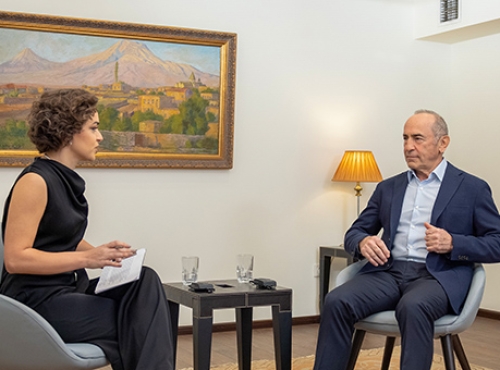


Armenia’s second President, Robert Kocharyan, stated that Yerevan deliberately paved the way for Russia’s peacekeepers to exit Nagorno-Karabakh by recognizing Azerbaijani territorial integrity in Prague.
In an interview with the 5th Channel, Kocharyan stated that, in his view, “everything was done by Armenia to force the Russians out of Artsakh.”
He pointed to Prime Minister Nikol Pashinyan’s statement in Prague, where he recognized Azerbaijan’s territorial integrity, including Nagorno-Karabakh, as the key trigger for Russia’s exit.
“The November 9 agreement bore the Russian President’s signature. He wasn’t just a witness; he assumed responsibility for security and deployed peacekeepers. Armenia unilaterally withdrew from that process. What did Armenia say in Prague? ‘I recognize Azerbaijan’s territorial integrity, including Artsakh.’
What role could Russia play after that in its relationship with Azerbaijan? Armenia effectively erased Russia’s mediator status with that statement,” he said.
According to Kocharyan, the final loss of Nagorno-Karabakh is a direct consequence of that declaration.
“The loss of Karabakh stems directly from the Prague statement. Where is Macron? Where is Charles Michel? Who even remembers them now?” he asked.
Kocharyan also commented on the documents signed between Armenia and Azerbaijan in Washington. He said a more effective peace agreement would include guarantees from Russia, the U.S., and China simultaneously.
“There are always ways to propose ideas that don’t negate previous steps but build on them. You offer a complementary alternative. We practiced that for 10 years and had good relations with Russia, the U.S., and Europe. When people asked how we managed it, I used to say that every major player has a sensitive spot, and we avoid stepping on it. We built our relations in areas where their interests align,” Kocharyan explained.
The Prague declaration reaffirmed Armenia and Azerbaijan’s commitment to the UN Charter and the 1991 Alma-Ata Declaration, through which both countries recognize each other’s territorial integrity and sovereignty. It forms the basis for ongoing border delimitation talks.