





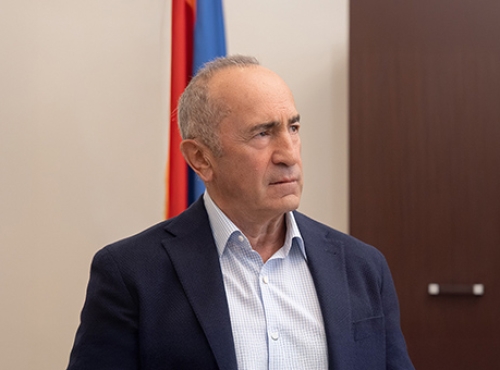


Armenia’s second President, Robert Kocharyan, accused Prime Minister Nikol Pashinyan of knowingly rejecting a Russian ceasefire proposal on October 18–19, 2020, during the 44-day war, despite being fully aware that defeat was imminent.
In an interview with the 5th Channel, Kocharyan stated, “What baffled me most was Pashinyan’s rejection of Russia’s offer to halt the war. Azerbaijan had agreed, but he still said no, despite knowing that defeat was inevitable, as the General Staff had reported that the army lacked the resources to continue fighting.”
Kocharyan recalled a relevant General Staff report and said Pashinyan explained his decision by saying he didn’t want to be labeled a traitor. “That decision cost our people at least 2,500 additional deaths and 5,000–6,000 wounded. Is that what a leader does?” he asked.
He also claimed Pashinyan is incapable of accepting advice, noting that since 2018, he had only met with Armenia’s first president and said he heard nothing new.
Kocharyan spoke of his own presence in Nagorno-Karabakh during the war, where he spent two weeks trying to convince then-President Arayik Harutyunyan to act. He said Harutyunyan refused to meet with him despite having a specific action plan.
“On the second day of the war, I was in Karabakh, and within a couple of days, I realized we would lose. Every day I tried, through Arkadi Ghukasyan and Bako Sahakyan, to persuade Arayik to do everything possible to stop the war. I even proposed a joint meeting with former and current presidents, despite my well-known opinion of Harutyunyan. He rejected the meeting, saying via Bako Sahakyan, ‘If I meet with Kocharyan, the Armenian prime minister will eat me alive.’ That’s a direct quote. During war, they feared talking to me more than Azerbaijan.”
Kocharyan also addressed the Washington agreements with Azerbaijan, arguing that the 9th clause of the November 9 trilateral statement and the reference to the Trump Route in recent documents were essentially the same.
“The 9th clause spoke of an unimpeded road. If you compare it with the similar clause in the Washington document, it’s the same in substance, except that back then, we still had Artsakh and the Lachin corridor. That clause was included to mirror Lachin. Instead of using that to secure the corridor’s functionality, Pashinyan consistently refused to implement it, leading to Lachin’s closure and the eventual loss of Artsakh,” he stated.
He emphasized that opposition forces were not the ones calling to cancel the November 9 statement.
“We understood it acknowledged defeat in war, but also recognized it as a document to preserve Artsakh. Yes, we should’ve clung to that document and done everything to implement it,” he added.
*On November 9, 2020, Russian President Vladimir Putin, Armenian Prime Minister Nikol Pashinyan, and Azerbaijani President Ilham Aliyev signed a trilateral ceasefire. Most of Nagorno-Karabakh, excluding Shushi and Hadrut, remained under Armenian control and connected to Armenia via the Lachin corridor, secured by Russian peacekeepers.
On September 19, 2023, Azerbaijan launched a large-scale attack on Nagorno-Karabakh, forcing Armenian authorities to accept a ceasefire the following day under terms proposed by Russian peacekeepers. This included disarming the local forces and dissolving the Republic of Artsakh. Over 100,000 residents fled to Armenia. As of late September, only about 20 Armenians remained in the region. Although an initial decree formalized Artsakh’s dissolution effective January 1, 2024, President Shahramanyan later issued a new order disputing that declaration.*