







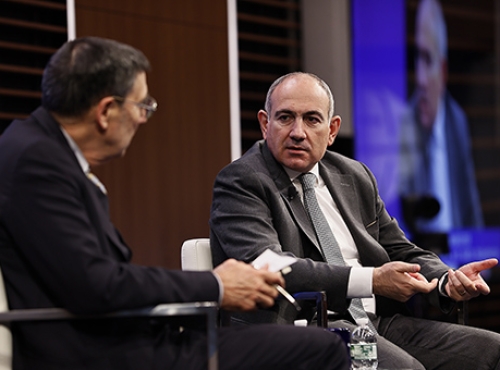


Armenian Prime Minister Nikol Pashinyan visited the Atlantic Council in Washington, D.C., where he delivered a speech and answered questions from John Herbst, Senior Director of the Atlantic Council's Eurasia Center and former U.S. Ambassador to Uzbekistan and Ukraine.
He stated that genuine and growing independence, prosperity, and security are unattainable without peace. "In Armenia, people are not very optimistic about the peace agenda," Pashinyan noted.
The Prime Minister also mentioned that the draft peace treaty contained many sensitive topics, but agreements have already been reached on all these issues.
"Peace is crucial even for democracy because we cannot have democracy in a war environment. I can say that due to historical factors, people in Armenia are not very optimistic about the peace agenda," he said.
Noting that there is agreement on 15 out of 17 points in the peace treaty negotiations with Azerbaijan, the Prime Minister stated that one point concerns the deployment of third-party forces along the Armenia-Azerbaijan border, and the other pertains to complaints filed against each other in legal structures.
"Azerbaijan proposes to prohibit the deployment of third-party forces along the border, referring to the European Union's civilian monitoring mission. We acknowledge Azerbaijan's desire and have made our own proposal, which suggests applying this point only in the delimited sections of the border. That is, if we have delimited a particular section, it means that third-party forces should not be present there. Thus, we have presented our proposal in writing and are awaiting Azerbaijan's response," he said.
Speaking about complaints against each other in legal structures, he noted that the idea is to cancel all such complaints.
"Overall, we are not against this idea either, but our proposal is not only to cancel these complaints but also not to raise these issues in bilateral relations. Otherwise, a strange situation may arise when, for example, a certain issue is canceled from an international structure's court, but one of the parties tries to put that issue on the table in bilateral relations and may use it to provoke tensions. In that case, it will no longer be possible to transfer that claim to international structures. We are not against that idea either. We propose to put an end to further discussions on conflict issues and open a new era of bilateral relations, starting from a new and clean page.
This means that all important issues of the draft peace treaty have already been agreed upon. There were very deep and sensitive topics in that draft, but agreements have already been reached on all these issues. For example, Armenia and Azerbaijan have agreed to recognize each other's territorial integrity based on the borders of Soviet Armenia and Soviet Azerbaijan.
We have agreed to include a provision that Armenia and Azerbaijan do not have territorial claims against each other and will not raise such claims in the future. This is essentially the cornerstone of future peace, and everything is agreed upon regarding it. Why am I saying this? Because it makes it obvious that now peace is more than accessible, and now only political will is needed to finalize, sign the draft peace treaty, and achieve lasting peace," he said.
On February 1, Nikol Pashinyan, along with his wife, Anna Hakobyan, traveled to the United States to participate in the 5th annual International Religious Freedom Summit, as well as the "National Prayer Breakfast."