









International law expert Ara Ghazaryan commented on the preliminary agreement signed between Armenia and Azerbaijan, noting that the mutual withdrawal of claims from international bodies—apart from affecting the 23 Armenian captives held in Azerbaijani prisons—could negatively impact more than 100,000 people forcibly removed from Artsakh, who lost property and social ties with no realistic prospect of restoration, according to Sputnik Armenia.
As of today, Armenia has filed four interstate complaints against Azerbaijan at the European Court of Human Rights and one at the International Court of Justice.
“Those who have already applied, or will within the next one or two years, might rely on legal protection from international tribunals—but proceedings may take a long time, and the form of protection remains unclear. Azerbaijan and Armenia should have committed to specifying how the matter would be resolved, yet the agreement merely says it will be resolved ‘otherwise.’ That’s very vague. Is it acceptable to include such an ambiguous term in an international treaty? Clearly, this reflects Azerbaijan’s intent to narrow any legal safeguards as much as possible. At most, the two words suggest that states agree to create some systems, but their outlines are unspecified,” Ghazaryan said.
He added that other international peace treaties typically include annexes detailing mechanisms for return, reparations, and compensation; the Armenia-Azerbaijan agreement lacks those.
“All that remains is to rely on legal protection mechanisms in Armenia—but none exist. The treaty includes no such mechanisms, creating ambiguity and unconstitutional conditions. A large number of citizens later may be unable to turn to international bodies. They cannot go to Armenian courts either, since the agreement envisages no legal protection mechanisms—leaving these individuals with no real protection. Is that normal? Certainly not. It’s unconstitutional. We’ll see whether any mechanism is established if the treaty is ratified,” he continued.
The expert reminded that international courts operate under their own rules and suggested that the existence of a peace treaty might lead a tribunal to advise against filing complaints on wartime or postwar matters.
“The only countermeasure that remains is individual complaints filed since 2021—though not many due to resource demands. This treaty may introduce delays that affect the number of applications. Ultimately, tribunals may say: Stop sending complaints—you’ve already signed an agreement. But since the treaty includes no protection mechanisms, I doubt international tribunals will refuse complaints, as they understand these people are left without legal protection,” he elaborated.
Regarding the captives held in Baku, he said one can only hope the agreement does not worsen their situation. They remain cut off from the outside world—a high risk—and are defended without lawyers.
Asked about U.S. President Donald Trump’s statement that he would ask for the release of the 23 Armenian Christians held in Baku, Ghazaryan replied that it’s purely political rhetoric.
“That a country's leader promised he’d talk doesn’t create legal process—it depends on political will. Relying on politicians is naïve. Of course results sometimes occur—several prisoner returns happened thanks to Russia’s interventions. That could happen here too. But I’m sure Azerbaijan will retain a number of individuals who’ll end up subjected to a final judicial decision. Azerbaijan wants an outcome to show the world that Armenia planned to undermine Azerbaijan’s sovereign independence in 'Azerbaijan’s certain territory.' Thus Armenia occupied Azerbaijan. But Azerbaijan lacks proof; its only legally admissible evidence must come from a judicial ruling—not the battlefield where Armenians acted in self‑defense,” he continued.
The lawyer added that in trials, questions often begin with “Armenia decided,” “Armenia ordered,” hinting that the former leadership of Artsakh—regardless of treaty signatures—may remain in Baku’s prisons as evidence that “Armenia occupied Azerbaijan for 30 years and the war was not for independence.”
He explained that Azerbaijan’s goal in detainee trials is to undermine the validity of Artsakh’s independence movement. A war for self‑determination does not equate to aggression. And the treaty’s references to territorial integrity don’t give Baku significant advantage—by joining the United Nations, a state automatically recognizes other members’ territorial integrity.
“Under provisions on territorial integrity, Azerbaijan gains nothing; on the contrary—it appears on the defensive regarding troop withdrawal from occupied Armenian territories. Otherwise, Azerbaijan’s only recourse is to create a disputed status and have those territories recognized as sovereign parts of Azerbaijan through delimitation,” the international law expert said.
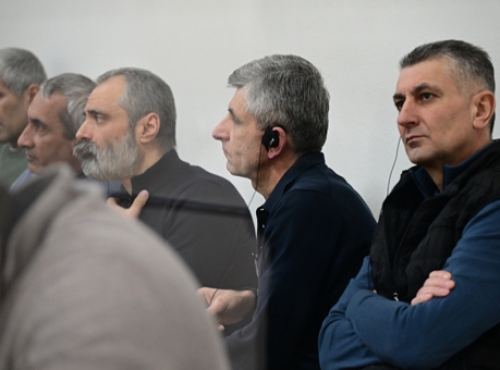
From January 17, trials are underway in Azerbaijan regarding former Artsakh political‑military leaders, including ex‑presidents Arkadi Ghukasyan, Bako Sahakyan, Arayik Harutyunyan, former defense army commander Levon Mnatsakanyan, former foreign minister David Babayan, and others. The case of former state minister and philanthropist Ruben Vardanyan is being heard separately.