





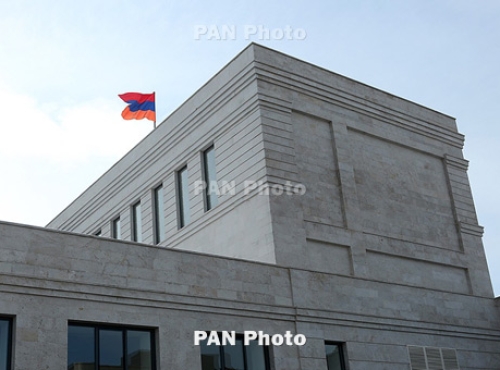


Armenia’s Ministry of Foreign Affairs (MFA) has confirmed that work on cataloguing negotiation documents related to the Nagorno-Karabakh issue is still ongoing. The ministry said the public will be properly informed about relevant developments in due time, RFE/RL reports.
It has now been more than nine months since Prime Minister Nikol Pashinyan instructed the foreign minister to register all negotiation documents archived within the ministry.
Prior to this directive, Pashinyan had invited Armenia’s three former presidents to a public debate, which they declined. First President Levon Ter-Petrosyan, instead of debating, proposed publishing all peace proposals made by the OSCE Minsk Group co-chairs, including the June 2019 version, along with Armenia’s official responses. The opposition has echoed similar demands, especially in light of Pashinyan’s claims that “since 1994, i.e. after the ceasefire, the negotiation process has been about returning Nagorno-Karabakh to Azerbaijan.”
Months later, Pashinyan renewed his invitation to debate. In response, Ter-Petrosyan said: “Let him publish all the documents. If he does, the debate is over.”
Political interpretations vary. The opposition argues that the 2019 proposal was made under the current government, and that with the Minsk Group no longer functioning, there are no legal obstacles to publicizing it. However, Deputy Speaker of Parliament Ruben Rubinyan has stated there is no political constraint, but the documents do not belong to Armenia alone.
Levon Zurabyan, Vice President of the Armenian National Congress (ANC), described the 2019 version as favorable, saying it offered a chance to preserve the Armenian status of Artsakh. Government officials counter that all proposals implied Karabakh’s return to Azerbaijan.
“If implemented, we would only need to return five districts to Azerbaijan, a full peace would be signed with peacekeepers deployed, and the issue of Karabakh’s status would be tied to the return of Kelbajar and Lachin—excluding the corridor section. This was a brilliant solution because it would pressure Azerbaijan into concessions on status if it wanted Kelbajar back,” Zurabyan stated.
As for what the 2019 document actually contained, MP Arman Yeghoyan of the ruling Civil Contract party outlined its main points to Factor TV: “Point one: return of 5 districts. Point two: reopening of communications. Point three: peacekeepers deployed to Nagorno-Karabakh. There were no international guarantees, only Russian.”
The ruling party claims the 2019 offer was a summary of the negotiation legacy left by former President Serzh Sargsyan. However, they have not clarified how the proposal progressed under Pashinyan’s leadership. Zurabyan maintains that the offer was rejected by the current government.
Rubinyan and Yeghoyan deny that any proposal was rejected under their administration.
“We have not rejected a single proposal for the settlement of the Nagorno-Karabakh conflict. Any claim to the contrary is a lie,” Rubinyan said.
If the opposition's timeline is accurate, by 2019 Pashinyan had already made his now-famous statements, including that Karabakh should return to the negotiating table.
Meanwhile, the “Nagorno-Karabakh Issue” section of the MFA’s official website remains inaccessible. Its title is visible, but content is missing.
In 2024, Elchin Amirbekov, Azerbaijan’s special envoy, said Baku did not accept the MFA’s wording describing “Artsakh as an inseparable part of historical Armenia.”
Last year, MFA spokesperson Ani Badalyan told RFE/RL the section had not been removed and would become available “within a reasonable timeframe.” She did not specify when. As of now, the content has been missing for over a year and a half.