









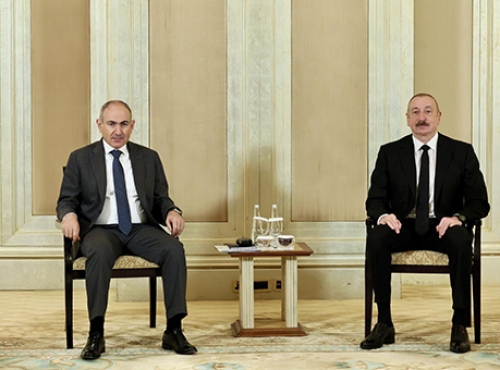


The Telegraph has published an article stating that leading analysts warn Azerbaijan’s and Armenia’s steps toward cooperation may reduce Moscow’s hold in the South Caucasus. On July 10, President Ilham Aliyev met with Prime Minister Nikol Pashinyan to discuss the so-called “Zangezur corridor” linking Azerbaijan with Nakhchivan. The article notes that under the 2020 ceasefire, Russia’s Federal Security Service was to monitor the route—but Aliyev now seeks full Azerbaijani control, excluding Moscow.
The article cites Nil Melvin, international security director at the Royal United Services Institute, who said this marks “Moscow’s last card in the region.” The Telegraph highlights that no final peace treaty exists between Armenia and Azerbaijan, yet positive signs are emerging; a formal agreement would significantly undercut Russia’s position in the South Caucasus.
The article also references Pashinyan’s July 10 visit to Turkey, after which President Recep Tayyip Erdogan noted that Armenia now shows “more flexibility on the Zangezur corridor,” despite earlier opposition. According to The Telegraph, Western envoys propose placing the corridor under neutral international management—perhaps Swiss or American firms—explicitly excluding Russia.
The Telegraph recalls that Russia’s influence in the region began declining in 2023 when its peacekeepers did not intervene during Azerbaijani military operations in Karabakh, prompting nearly all of the region’s Armenian population to leave and accusations of ethnic cleansing against Baku.
In response, the article states, Pashinyan has pivoted westward and pursued détente with Baku, warning that Armenia’s long-term future is at risk unless enmity with Azerbaijan and Turkey ends. Though this shift remains unpopular domestically and has cost Pashinyan global approval, The Telegraph concludes that Armenia and Azerbaijan—former Soviet satellites—are charting a new path without Russia.
U.S. ambassador Thomas Barrett announced Washington’s plan to lease the 32‑km passage for 100 years, posing as a neutral manager for Armenian‑Azerbaijani regional transit.