







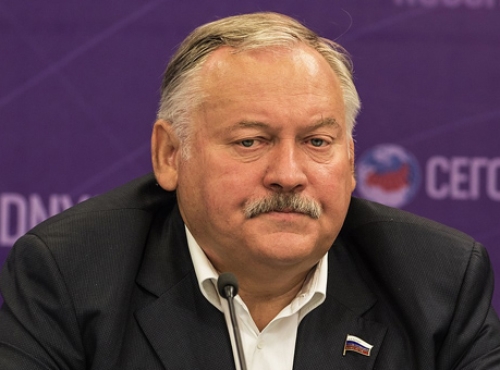


Russian State Duma member Konstantin Zatulin, commenting on the expected August 8 signing of a peace document in Washington between Azerbaijani President Ilham Aliyev and Armenian Prime Minister Nikol Pashinyan under U.S. President Donald Trump’s mediation, said that if the reports are accurate, the United States is entering the South Caucasus — and Russia and Iran are being asked to accept it.
“At a time when the whole world speculates about a Putin–Trump meeting, Russia’s two ‘loyal friends,’ Ilham Aliyev and Nikol Pashinyan, have rushed to Washington to strike a deal under the supervision of the U.S. president. Whether they sign a so-called peace treaty or just an interim memorandum, there’s no need to be a fortune-teller to see this is a deal that brings America into the region, while Russia and Iran are told to live with it. Regardless of whether it’s in the text of any agreement, a final decision will be made on the so-called ‘Zangezur corridor’ and its control. Using Pashinyan, Turkey will open a direct route through Armenia to Azerbaijan, the Caspian region, and Central Asia — along with NATO and the U.S., who will get their bonus,” Zatulin told EADaily.
He said the indirect participants in the Washington talks will be Turkey, Russia, Iran, and possibly Israel. In his view, for Turkey, Israel, the U.S., and Azerbaijan, this is the realization of national interests, while for Russia and Iran, it means a loss of influence and a need to urgently revise plans — including the “North–South” transport corridor, which would be countered by Zangezur’s “West–East” route.
“The most outrageous part is Armenia’s participation. I hate to say it, but by bringing Pashinyan to power, his voters have passed sentence upon themselves and on Armenia. There is no national interest here,” he said.
Zatulin recalled that the “Zangezur corridor” idea was part of the agreements reached between Armenia, Azerbaijan, and Russia after the 2020 Nagorno-Karabakh war. It was then seen as a counterbalance to the functioning Lachin corridor and a potential route through Syunik. Now, he said, there are no Armenians left in Karabakh, the Lachin corridor is closed, and with that, any need to coordinate with Russia has disappeared — something the Washington meeting’s participants are openly showing.
He added that what is now happening is not only the result of certain miscalculations but also an objective consequence of Russia’s weakening in the region due to the war in Ukraine and confrontation with the West.
On August 8, U.S. President Donald Trump will host Pashinyan and Aliyev at the White House. Separate meetings will be followed by a trilateral session, during which Trump says they will officially sign a peace agreement along with other documents.