













The Lemkin Institute for Genocide Prevention has issued a critical response to the recently announced Armenian-Azerbaijani agreements reached in Washington, warning that the “premature celebration of peace” ignores Azerbaijan’s “genocidal threats” and the dangers to Armenia’s sovereignty.
“The deal announced in Washington could easily lead to renewed war and destruction, and could serve as a foundation for further genocidal actions against Armenians by Azerbaijan. Specific mechanisms to protect Armenia’s sovereignty should have been included in the agreement text and implemented in reality,” the statement reads.
The Institute points out that the document omits key issues such as the fate of Armenian prisoners and the genocidal actions committed by Azerbaijan in Artsakh in 2023. Instead, it forces Armenia to withdraw its legal claims against Azerbaijan from the European Court of Human Rights and the International Court of Justice, effectively “erasing the legal paths to justice and truth.” Moreover, no new legal proceedings on these issues will be possible in the future.
The Lemkin Institute described this as a serious threat.
“These are currently the only legal mechanisms capable of providing some level of justice and accountability for both Armenia and Azerbaijan after decades of war over Nagorno-Karabakh. Armenia, as a victim of Azerbaijani aggression and hatred, stands on far stronger legal ground. That is why Azerbaijan was so eager to ensure the cases were dropped under this ‘peace’ deal. If Armenia retracts its cases alongside Azerbaijan, it would also mean abandoning efforts to hold Azerbaijan accountable and to seek justice for the over 100,000 Artsakh Armenians forcibly displaced in 2023,” the statement continues.
The agreement also fails to address the ongoing authoritarian and genocidal policies of Azerbaijani President Ilham Aliyev, the continued occupation of Armenian territories, the destruction of Armenian cultural heritage, the status of Artsakh, and the rights of displaced Armenians from Nagorno-Karabakh.
The Lemkin Institute noted that the dismantling of the OSCE Minsk Group—executed even before the signing of the peace agreement—was done at Baku’s request, severely undermining the protection of Artsakh Armenians' rights. The Minsk Group was the only international diplomatic platform recognizing those rights.
According to the Institute, the Washington agreement prioritizes U.S. geopolitical interests over Armenia’s security.
“For Armenia to be truly secure, the U.S. must pressure Azerbaijan to make changes and concessions, as required by international law. This includes the withdrawal of troops from Armenian territory, the release of all Armenian hostages, and internal reforms in Azerbaijan to neutralize state-sponsored Armenophobia. The U.S. must also support the creation of an international legal mechanism capable of addressing all historical claims between the two countries,” the statement says.
While the U.S. has assumed a mediating role to ensure Armenia’s security and sovereignty, the Lemkin Institute questions whether American leadership fully grasps the scope of the threats emanating from Azerbaijan.
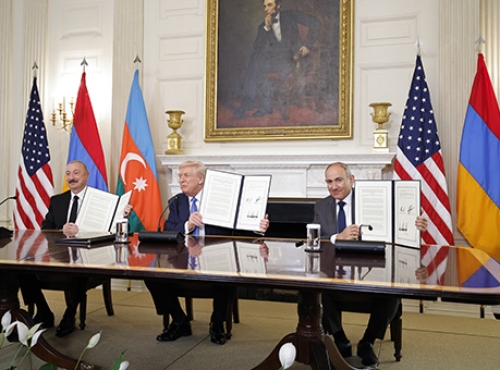
On August 8, a trilateral meeting between Armenian Prime Minister Nikol Pashinyan, U.S. President Donald Trump, and Azerbaijani President Ilham Aliyev was held at the White House, resulting in the signing of a joint Declaration outlining the outcomes of the Washington summit.
During the summit, Armenian Foreign Minister Ararat Mirzoyan and Azerbaijani Foreign Minister Jeyhun Bayramov initialed a draft agreement on “the establishment of peace and interstate relations between the Republic of Armenia and the Republic of Azerbaijan,” in the presence of their countries’ and U.S. leaders.