






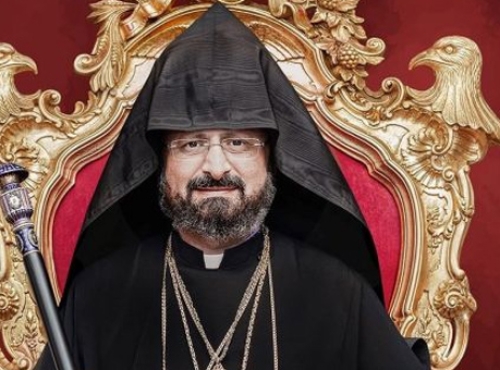


The Armenian community of Turkey hopes for normalized relations between Armenia and Turkey, said Armenian Patriarch of Constantinople, Archbishop Sahak Mashalyan, during a meeting with journalists from Armenia in Istanbul, Armenpress reports.
“Our community supports the Armenia-Turkey normalization process. We want closer ties because it would ease a huge burden we carry. For the past 100 years, Armenia-Turkey relations have been so strained that here, the word ‘Armenian’ is practically an insult. And in Armenia, it’s the same with the word ‘Turk’. If relations improve, the heaviest weight will lift off our shoulders. We deserve to breathe in a friendlier atmosphere,” the Patriarch said.
Mashalyan noted that the community closely follows official exchanges between Yerevan and Ankara, such as cross-border infrastructure projects, restoration of Ani’s bridge, and Turkish airline entry into the Armenian market.
“These processes are underway. But we, as short-lived beings, want quick results, whereas the lives of nations move slower. Looking at Turkey-Armenia relations, I see many reasons for optimism,” he said.
Regarding the Turkish government, Mashalyan acknowledged positive shifts under the current administration.
“We regained properties, obtained greater freedoms, and today we can renovate churches and buildings. There was a time when we needed permission just to hammer a nail. Now things are much easier. The president, ministers visit us, and we are invited to state events,” he said.
However, Mashalyan warned that demographic decline is the biggest threat to the future of the Armenian community in Turkey. With a current population of 35–40,000, he projected a drop to 10–15,000 in the next 25 years. “Our institutions were built for 125,000 people. We have 50 churches, but we can’t fill them anymore. We used to have 50 schools — now we have only 17.”
In Istanbul’s Armenian neighborhoods, the change is stark. “In Kumkapı, where the patriarchate and our cathedral are located, there were once 40,000 Armenians. Now, fewer than 40 live there.”
Mashalyan also highlighted the community’s struggle to preserve the Armenian language, which he said is essential to resisting cultural assimilation. “Losing the language means losing the culture. If you don’t speak the language, you can’t access the culture. We are trying to hold on. We have 3,000 students in our schools. The schools do a great job. They help preserve our literary, linguistic, and cultural heritage. We are among the diaspora’s strongest communities, and we pray to continue as we have for the past 600 years around the church,” he concluded.